Search for ISO 42001 guidance and you will find plenty written for compliance teams, auditors, and engineers, and almost nothing written for the profession that may be the best fit of all: business analysis.
That is a gap worth closing, because ISO/IEC 42001:2023, the first international standard for artificial intelligence management systems, asks organizations to do exactly the things business analysts already do for a living. It asks them to understand stakeholders, define requirements, assess impact, model processes and document decisions, only now for AI.
If you are a business analyst wondering whether this standard is relevant to you, the honest answer is that you are closer to it than most people who currently hold the certificate. The AI Governance Certification Institute (AIGCI) wrote this guide specifically for you: what ISO 42001 expects, how your existing skills map onto it, which certification to choose, and where it can take your career.
Business analysts are exceptionally well suited to AI governance because ISO/IEC 42001:2023 is built on requirements, stakeholder, impact, and documentation work that sits at the heart of business analysis, which is why the Lead Implementer certification is usually the right fit for a BA.
Why business analysts are unusually well suited to AI governance
Most professions approaching AI governance have to learn a new way of thinking. Business analysts largely do not. The core of business analysis is turning ambiguous needs into clear, testable requirements while keeping every stakeholder aligned and every decision traceable.
An AI management system needs precisely this discipline. Someone has to work out who is affected by an AI system, what the organization actually requires of it, how it should behave across its lifecycle, and how all of that is recorded so it can be reviewed and audited.
That is a requirements-and-stakeholder problem before it is a technical one, and it is the problem business analysts solve every day.
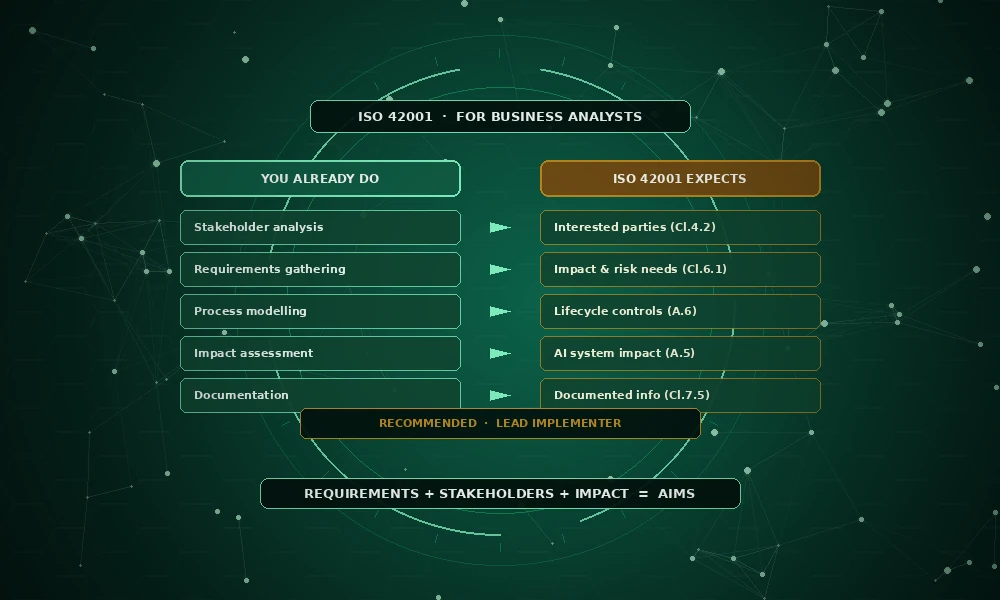
The clearest way to see the fit is to place the two side by side. Almost every routine business analysis skill has a direct counterpart in ISO 42001, as the mapping below shows.
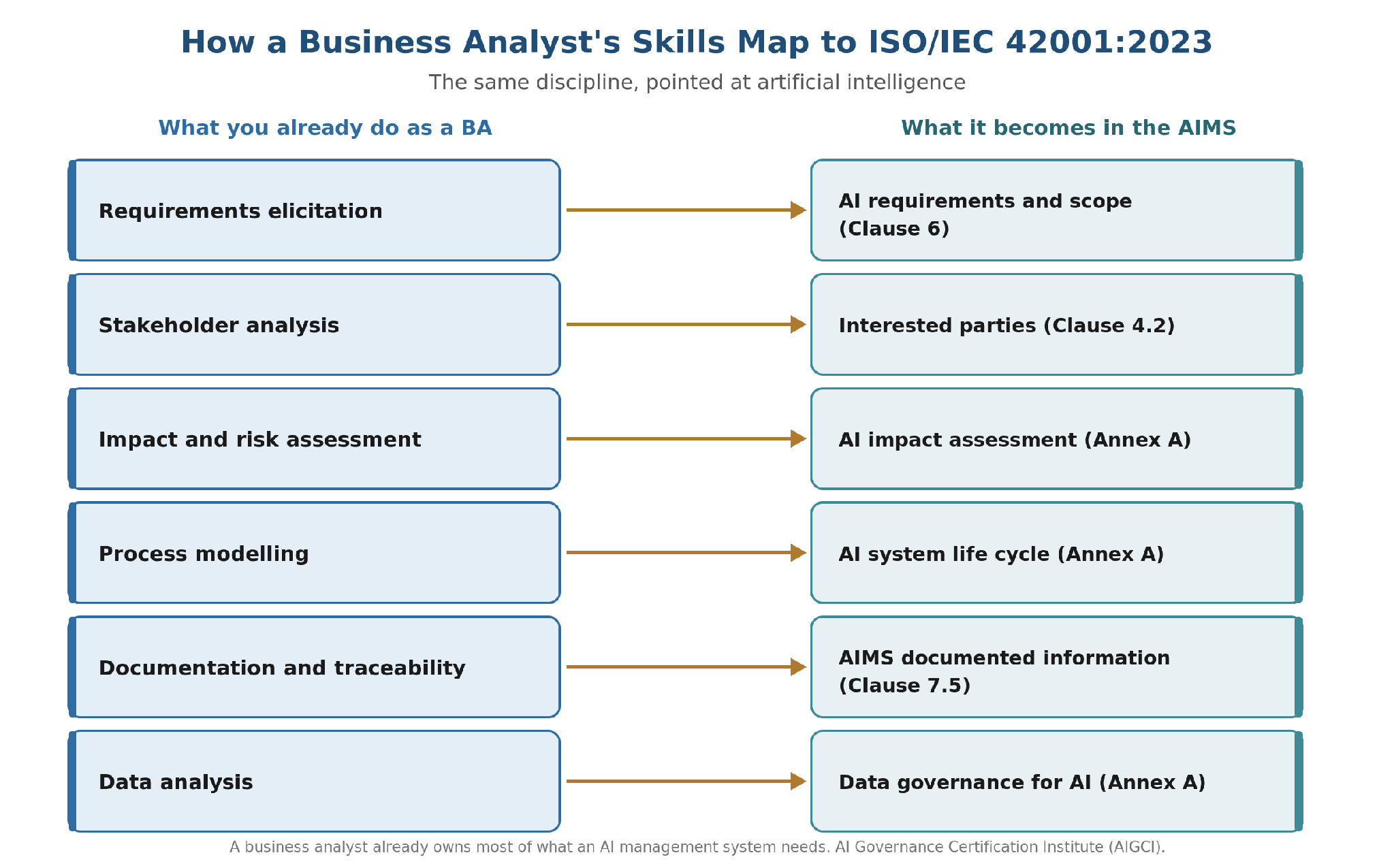
Figure 1. A business analyst already owns most of what an AI management system requires.
The same mapping, described in a little more detail, makes the point even harder to argue with.
|
Business analysis skill |
Maps to in ISO 42001 |
Why it matters |
|---|---|---|
|
Requirements elicitation |
Defining AI requirements and AIMS scope |
Sets what the AI must and must not do |
|
Stakeholder analysis |
Identifying interested parties (Clause 4.2) |
Names who the AI affects and who decides |
|
Impact and risk assessment |
AI impact assessment (Annex A) |
Surfaces bias, safety, and rights concerns early |
|
Process modelling |
Mapping the AI system life cycle |
Shows where controls and approvals belong |
|
Documentation and traceability |
AIMS documented information (Clause 7.5) |
Creates the evidence an auditor will look for |
|
Data analysis |
Data governance for AI (Annex A) |
Governs the quality and provenance of training data |
None of this requires you to build models or write code. It requires you to do requirements, stakeholder, and process work with AI as the subject, which is a translation of existing strength rather than a leap into the unknown.
This is also why the industry is actively pulling business analysts toward the discipline. The Institute of Business Analysis now frames AI readiness as a core competency for the modern analyst, arguing that the profession must extend its methods to the governance and delivery of AI rather than stand apart from it.
What ISO 42001 actually asks of a business analyst
It helps to be concrete about where a business analyst adds value inside an AI management system, because the standard is not abstract about it. Several of its requirements read almost like a business analysis brief.
Understanding the organization and its interested parties
ISO 42001 opens by requiring an organization to understand its context and the needs of interested parties. That is stakeholder analysis by another name. A business analyst is trained to identify who has a stake, what they need, and where those needs conflict, which is exactly what this part of the standard demands for AI.
Assessing the impact of AI systems
The standard requires organizations to assess how their AI systems affect individuals and society, not just the business. Business analysts already run impact and options analysis; here the lens widens to include fairness, transparency, safety and the rights of people affected by an automated decision. The method is familiar even where the subject is new.
Turning policy into requirements and controls
An AI policy is only useful when it becomes concrete requirements that teams can act on and auditors can check. Translating high-level intent into specific, testable requirements is the defining business analysis skill and it is what turns an AI management system from a document into a working reality.
Documenting decisions so they can be trusted
Clause 7.5 of the standard requires documented information, and the whole system depends on records that show what was decided, by whom and why. Business analysts are custodians of traceability. The same rigour that links a requirement to a test case links an AI decision to the control that governs it.
Which ISO 42001 certification a business analyst should choose
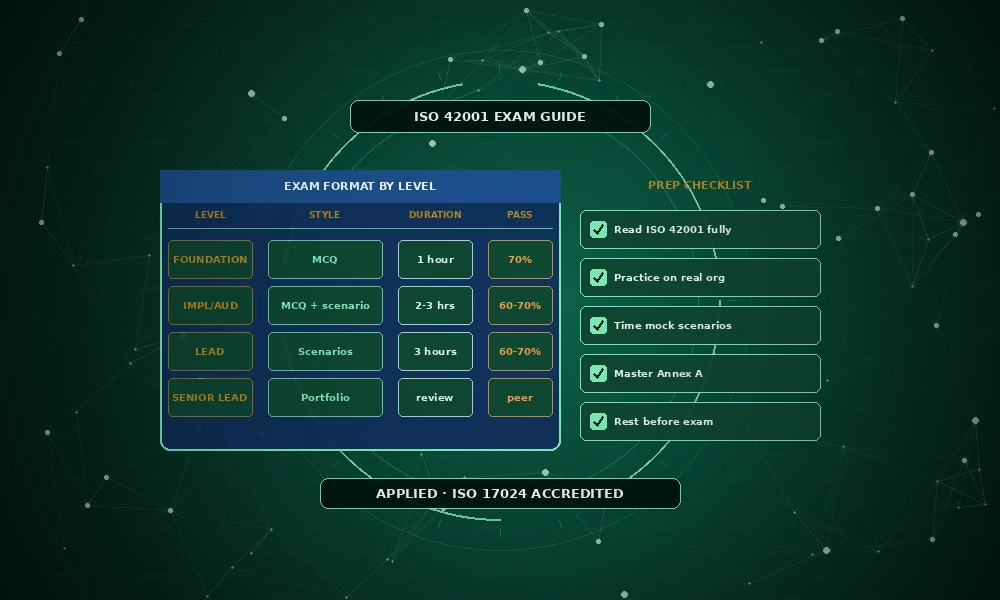
Two certification levels matter most to a business analyst, and the right choice depends on how far you want to go. The Foundation level builds working knowledge of the standard and is a sensible first step if you are still exploring.
The Lead Implementer level, however, is usually the better fit, because implementing an AI management system is fundamentally a requirements, stakeholder and delivery exercise, and that is your home ground.
|
Level |
What it develops |
Best for a BA who wants to |
|---|---|---|
|
Foundation |
Awareness of the standard and its concepts |
Explore AI governance and speak the language |
|
Lead Implementer |
Ability to build and run an AIMS end to end |
Lead AI governance work, the natural BA route |
A common worry is whether a business analyst needs a technical or data-science background first. In almost all cases the answer is no, and it is worth reading our dedicated explainer on whether you need AI experience before you rule yourself out.
For a full picture of what the recommended path involves, including scope, effort, and outcomes, see the Lead Implementer guide. The short version is that a business analyst brings most of the transferable skills the Lead Implementer role assumes, and fills the rest through the certification itself.
The career payoff: where a certified business analyst can go
Business analysis is already a healthy career. The US Bureau of Labor Statistics projects that employment of management analysts, the category that includes many business analysts, will grow about 9 percent between 2024 and 2034, much faster than the average across all occupations, at a median wage of 101,190 dollars in 2024.
Layer AI governance on top of that and the trajectory steepens, because demand for people who can oversee AI is rising sharply. Gartner projects that by the end of 2026 roughly 40 percent of enterprise applications will include task-specific AI agents, up from less than 5 percent at the start of 2025 and every one of those systems needs someone to govern it.
That demand is opening a family of roles a certified business analyst can step into: responsible AI analyst, AI governance analyst, AI governance manager and AI compliance or risk roles. These positions typically command a premium over general analyst pay, reflecting the scarcity of people who can bridge business, risk and AI.
In practical terms, an ISO 42001 certification lets a business analyst reposition from analysing business change in general to governing AI specifically, which is one of the faster-growing corners of the profession.
And because certification is increasingly requested in procurement and shaped by regulation such as the EU AI Act, the credential also travels with you into organizations that must prove their AI is well governed.
How a business analyst can get started
The path is short and unusually low-risk for a business analyst. Start by reading the standard against what you already do, using the mapping above to recognise how much of it you have practised for years.
Decide your destination: Foundation if you want to explore, Lead Implementer if you intend to lead AI governance work. Then close the two genuine gaps, which are the AI-specific content of the standard, such as impact assessment and AI data governance, and the vocabulary of responsible AI.
A structured certification covers both. From there, look for AI governance work inside your current organization before you look outside it, because the fastest route into the field is usually to volunteer for the AI project everyone else finds unfamiliar and you find surprisingly familiar.
What the work looks like in practice
In the AI governance work we see, a business analyst rarely starts from a blank page. They start by interviewing the people who own an AI system and asking the questions they have always asked: what is this meant to do, who relies on it, what happens when it is wrong and how would we know.
Those conversations become an impact assessment, a set of requirements and a map of where human oversight belongs. It is recognisably business analysis, applied to a system that happens to learn from data rather than follow fixed rules.
The part that is genuinely new tends to be narrow. A business analyst moving into AI governance has to get comfortable with a handful of AI-specific ideas: how bias enters a model through its training data, why explainability matters for certain decisions, and what transparency obligations attach to automated outcomes.
These are learnable in weeks rather than years, precisely because the surrounding discipline of eliciting, analysing, documenting, and validating is already second nature. That is the honest shape of the transition, a large base of transferable skill and a small, well-defined amount of new material to absorb.
The roles this opens up
Certification does not lock you into a single job title. It positions a business analyst for a spread of adjacent roles, each of which leans on the analysis skills you already have.
|
Role |
What it focuses on |
Typical route for a BA |
|---|---|---|
|
Responsible AI analyst |
Assessing AI for fairness and transparency |
Foundation, then hands-on practice |
|
AI governance analyst |
Running day-to-day AIMS activities |
Lead Implementer |
|
AI governance manager |
Owning the AI governance programme |
Lead Implementer plus experience |
|
AI compliance or risk analyst |
Mapping AI obligations to controls |
Lead Implementer plus domain knowledge |
Each of these is a specialisation you can grow into rather than a wall you have to climb. For a business analyst, that gentle on-ramp is the whole point: you are not restarting a career, you are extending one into the fastest-moving area of it.
Common questions from business analysts
Do I need a technical or coding background to certify?
No. ISO 42001 governs how AI is managed, not how it is built. A business analyst needs to understand how AI systems behave and where the risks sit, which the certification teaches. You do not need to train models or write code.
Which ISO 42001 certification should a business analyst take?
Most business analysts are best served by the Lead Implementer certification, because implementing an AI management system is a requirements and delivery exercise that suits the BA skill set. Foundation is a good starting point if you want to explore first.
Is ISO 42001 certification worth it for a business analyst?
For analysts moving toward AI, yes. It converts existing strengths into a recognised AI governance credential at a time when demand is rising and the roles command a premium. It also signals to employers that you can govern AI, not just document it.
How is AI governance different from what I already do?
The method is largely the same, but the subject and the stakes change. You apply requirements, stakeholder, and impact analysis to AI systems, adding concerns such as bias, transparency, and human oversight that traditional projects rarely surfaced.
Does ISO 42001 replace my IIBA certification?
No. They complement each other. An IIBA credential such as CBAP proves your business analysis capability; ISO 42001 proves you can apply it to AI governance. Together they position you strongly for AI-focused analyst roles.
Can I move into AI governance without leaving business analysis?
Yes, and many people do exactly that. AI governance is often a specialisation of business analysis rather than a departure from it, so you can grow into it inside your current role before deciding whether to make it your full focus.
Turn your analysis skills into AI governance authority
If the mapping in this guide felt like a description of your own job, you are ready to formalise it. AIGCI's route to becoming a certified ISO 42001 Lead Implementer is built for professionals who already think in requirements, stakeholders and processes, so it develops the AI-specific knowledge you need without relearning the fundamentals you already have.
To see how the institute structures its programme and supports career changers, read more about the institute.