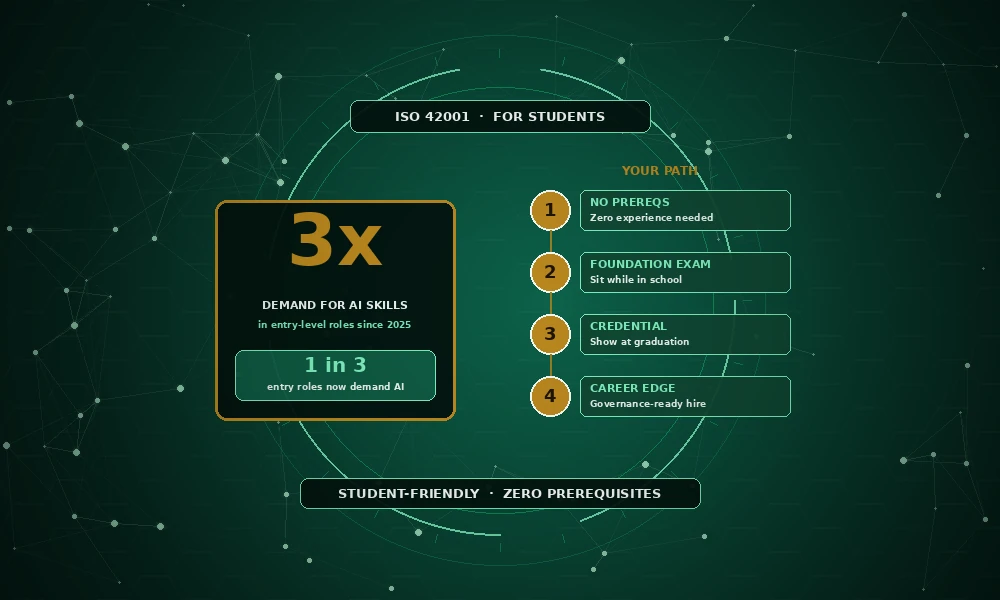
Employers are changing what they expect from graduates, fast. Demand for AI skills in entry-level jobs has nearly tripled since late 2025, and more than a third of entry-level roles now ask for them outright. That is a problem for most students and an opportunity for a few.
Using AI in your coursework is now ordinary; being able to govern it responsibly is rare. This is where ISO/IEC 42001:2023, the international standard for AI management systems, gives a student an edge. Its Foundation level has no prerequisites, no experience requirement and no coding barrier, which makes it one of the few professional credentials a student can genuinely earn before graduating.
This guide, from the AI Governance Certification Institute (AIGCI), explains why it is worth it, who it suits, and how to start.
A student can earn an ISO/IEC 42001:2023 Foundation certification with no prior experience, which turns AI from something you merely use into something you can prove you understand how to govern.
|
"The illiterate of the 21st century will not be those who cannot read and write, but those who cannot learn, unlearn, and relearn." Widely attributed to futurist Alvin Toffler, Future Shock (adapting a formulation by psychologist Herbert Gerjuoy) |
For a student, that is the whole case in one sentence. The graduates who thrive will be the ones who learn the newest thing before everyone else has to. AI governance is that newest thing, and a recognised credential in it is proof you can learn fast in the direction the market is moving.
Why ISO 42001 is a smart early move for a student
Certifying in AI governance while you study is unusual, and that is exactly why it works. Five reasons stand out:
- You can start with zero experience. The Foundation level has no prerequisites, so being a student is not a barrier.
- The field is brand new. Few people hold any AI governance credential yet, so an early one carries rare weight.
- It separates you from the crowd. Almost every graduate now uses AI; very few can show they know how to govern it.
- It complements any degree. This is not a computer-science credential; it adds to law, business, policy, and more.
- It signals AI literacy. Employers increasingly treat AI literacy as a baseline, and a certificate is concrete evidence of it.
You do not need experience, and for a student that is the point
The most common reason students rule themselves out is a belief that they need work experience or a technical background first. Neither is true at the Foundation level. If you are unsure, our dedicated explainer on whether you need experience walks through it, but the short answer is that the standard is about how AI is managed and governed, not how it is engineered.
The recommended starting point for anyone new, students included, is the ISO 42001 Foundation certification, which builds working knowledge of the standard and the language of responsible AI from the ground up. In tracker terms, a student starts with Foundation and grows from there.
Which students benefit most from ISO 42001
A frequent misconception is that AI governance is only for technical students. In reality it rewards a wide range of backgrounds, because governing AI is as much about people, rules, and processes as it is about models. The table below shows what the certification adds, whatever you study.
|
If you are studying |
What ISO 42001 adds |
|---|---|
|
Computer science or data |
Governance and responsible-AI context around the technology you already understand |
|
Law, policy, or regulation |
The management-system and controls side of the AI rules you are learning |
|
Business or management |
How AI governance is actually operationalised inside an organization |
|
Ethics or philosophy |
A practical framework for turning ethical principles into working controls |
|
Any field that uses AI |
Credible proof that you can govern AI, not merely use it |
The pattern is consistent: whatever your subject, ISO 42001 gives you the vocabulary and structure to be the person in the room who can connect AI to responsibility, risk and the law.
That connecting role is scarce today and will only grow more valuable, because most organizations have plenty of people who can build or use AI and very few who can govern it well.
What the Foundation certification actually gives a student
Foundation is designed as an entry point, so it focuses on understanding rather than implementation. By the end you can expect to:
- Explain what an AI management system is and why organizations need one.
- Describe the core ideas of responsible AI: fairness, transparency, human oversight, and accountability.
- Recognise how ISO 42001 is structured and how it relates to AI risk.
- Speak credibly about AI governance in an interview or an internship.
That last point matters more than students expect. The gap employers complain about is not that graduates cannot use AI tools; it is that they cannot talk about governing them, cannot explain why a model might be unfair or how a decision should be overseen.
Foundation closes exactly that gap, and it does so with a vocabulary that hiring managers recognise from the standards and regulations shaping their own AI programmes.
How ISO 42001 fits alongside your degree, not instead of it
A certification is not a replacement for your studies; it is a multiplier on them. Your degree gives you depth in a subject, and ISO 42001 gives you a way to apply that subject to the fastest-growing area of risk in almost every industry. The two compound. A law student who can also speak the language of AI management systems is more useful than either a pure lawyer or a pure technologist.
A data student who understands governance is trusted with decisions that a coder alone is not.
Practically, students tend to fit it in around their studies in a few ways:
- Alongside a relevant module, so the theory in class meets a real framework.
- Over a break or between terms, when a focused block of study is easiest.
- As the backbone of a capstone or dissertation that touches AI and responsibility.
However you fit it in, the result is the same: you leave university able to point to a recognised credential, not just a transcript.
Why the timing is unusually good for students
The market data lines up neatly in a student's favour. Three findings make the case:
- Entry-level demand has tripled. Employers reporting to NACE say AI skills in entry-level jobs have nearly tripled in under a year.
- AI literacy is becoming a baseline. Around half of hiring managers expect AI literacy to be a standard job requirement within two years, business-education research reports.
- The formal-training gap is wide. A large majority of recent graduates used AI in college, but only a minority received any formal instruction in it, leaving room for those who can show real, structured knowledge.
Regulation reinforces the trend. Under the EU AI Act, organizations must ensure their staff have a sufficient level of AI literacy, which turns what was a nice-to-have into something employers will actively screen for.
A student who arrives already certified is answering a question the market has only just started asking.
Where an ISO 42001 credential can take a graduate
A Foundation certification does not hand you a senior title, but it opens a set of realistic entry points that many graduates never even see. Each rewards the governance literacy the certificate proves.
|
Entry-level role |
What it involves |
|---|---|
|
Junior AI governance analyst |
Supporting day-to-day AI management activities and documentation |
|
Responsible AI analyst |
Helping assess AI systems for fairness, transparency, and safety |
|
Governance, risk, and compliance analyst |
Mapping AI obligations to controls within a GRC team |
|
AI policy or research assistant |
Supporting AI policy, standards, and governance research |
None of these expects a decade of experience. They expect someone who understands how AI should be governed and can be trusted to help, which is precisely what a student can demonstrate with a Foundation credential and a project to point to.
How a student can get started
- Confirm you do not need experience. At Foundation level, you do not.
- Start with the Foundation certification to build the core knowledge and vocabulary.
- Apply it quickly: use a class project, capstone, or internship that touches AI.
- Put it on your CV and LinkedIn as concrete evidence of AI governance literacy.
- Grow toward the Lead Implementer level once you have some practical experience.
Three myths that stop students from starting
A few assumptions do more harm than any real barrier. Retire these:
- Myth 1: I am too junior. Reality: Foundation is built for beginners, and being early is an advantage in a field this new.
- Myth 2: it is only for tech students. Reality: law, business, policy, and ethics students may benefit most, because governance is their home turf.
- Myth 3: I should wait until I have a job. Reality: arriving already certified is what helps you get the job, not the other way around.
From student to a first AI governance role
The realistic path is shorter than most students imagine. It usually runs like this: earn the Foundation certification, then find one concrete way to use it, a class project, an internship, a volunteer role helping a society or a small organization think about its AI. That single piece of applied work, paired with the credential, is often enough to stand out for an entry-level governance or GRC role.
From there, the field rewards momentum. The professionals who are now leading AI governance were, in many cases, early movers who simply started before it was obvious. A student who begins now is not behind; they are ahead of almost everyone who will graduate alongside them, because they will arrive able to prove they can govern AI rather than only claim to use it.
Questions students ask
Can a student really get certified with no work experience?
Yes. The ISO 42001 Foundation certification has no prerequisites and no experience requirement, so students can take it while studying. It is one of the few genuine professional credentials available before graduation.
Which certification should a student start with?
Foundation. It builds the core understanding of AI management systems and responsible AI, and it is the natural first step before more advanced levels such as Lead Implementer, which suit those with some experience.
Do I need to study computer science?
No. ISO 42001 governs how AI is managed rather than how it is built, so students from law, business, policy, ethics, and many other fields are well placed. A general understanding of how AI behaves is enough.
Is it worth doing before I graduate?
For students aiming at AI-adjacent roles, yes. It differentiates you in a crowded graduate market, provides concrete evidence of AI literacy, and lets you speak credibly about governance in interviews.
Will employers actually recognise it?
A credential from a credible body signals real, structured knowledge rather than casual tool use. As AI literacy becomes a hiring baseline, that recognition is growing quickly, especially for early-career candidates.
What comes after Foundation?
Once you have some experience, the Lead Implementer level lets you build and run an AI management system end to end. Many people start with Foundation as a student and progress as their careers develop.
Graduate as the person who can govern AI
If you are still studying, you are in the best possible position to get ahead of this shift rather than chase it. AIGCI's ISO 42001 certification programmes for beginners are built for people starting from scratch, so you can earn a recognised AI governance credential alongside your degree and walk into the job market able to prove it.
The field is still forming, which means the students who move first will help define it rather than compete to catch up. To see how the institute supports students and career starters, read more about the institute.