Every organization heading toward ISO 42001 wants the same two things: a clear map from where it is now to a certificate it can defend, and an honest sense of how long that takes. This is that map. Under ISO/IEC 42001:2023, the AI management system standard, the route has five stages, and the single most useful thing to understand up front is that it does not end at the certificate.
That framing matters because the common mental model is wrong. Certification is not a project with a finish line; it is the point where an ongoing system becomes independently verified. An organization earns the certificate at one audit and then keeps it through years of surveillance and improvement. Treat the roadmap as a loop that tightens, not a line that ends, and every later decision gets easier.
This pillar from the AI Governance Certification Institute (AIGCI) walks the whole journey: the five stages, realistic timelines, who owns the work, and what happens after you pass. It links out to the detail at each step, and it pairs with what training includes for the teams who have to carry it.
The ISO 42001 Certification Roadmap at a Glance
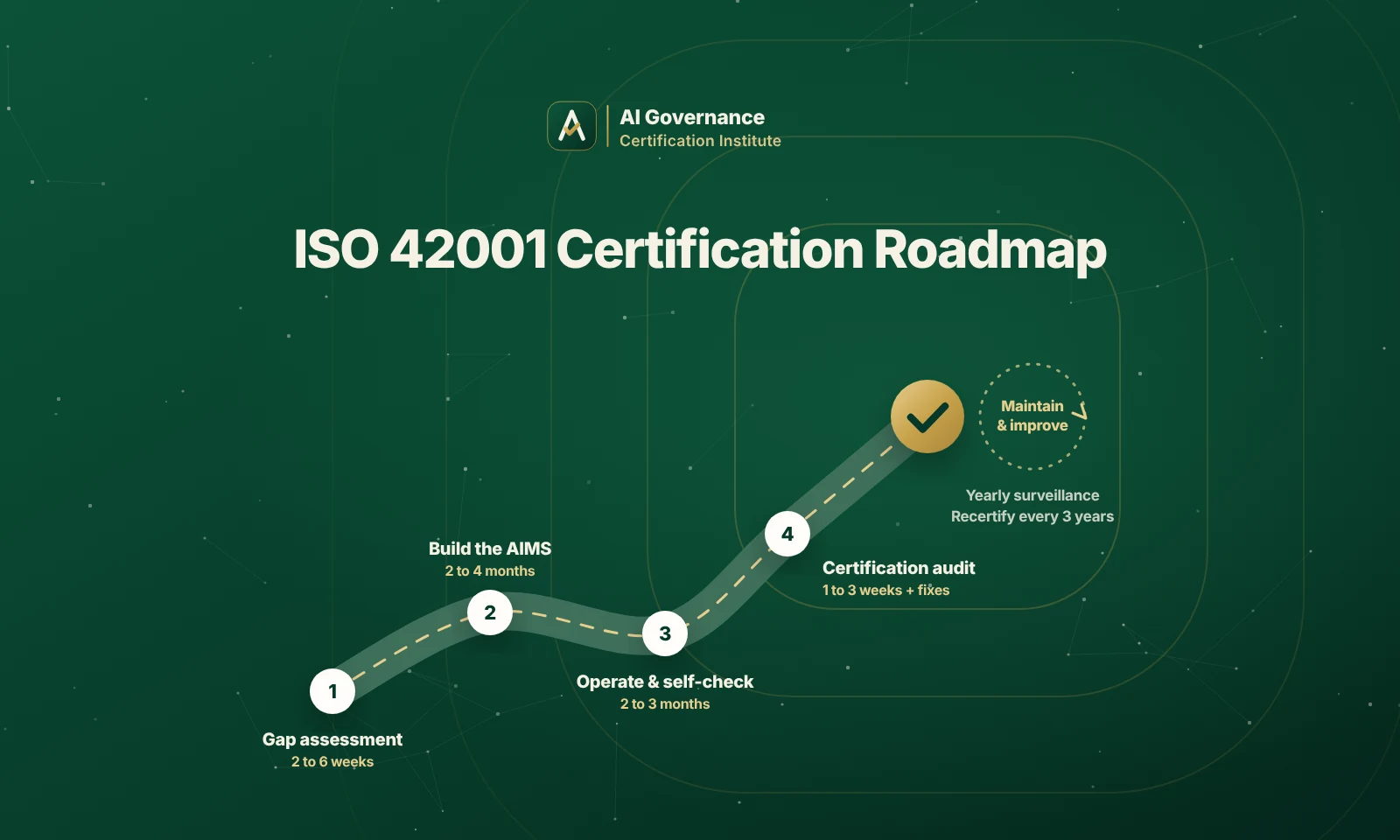
Before the detail, the shape of the whole journey. The table lays out the five stages, what happens in each, and a realistic duration drawn from how organizations actually move. Treat the durations as ranges that depend on your starting maturity and the scope you choose, not promises.
|
Stage |
What Happens |
Typical Duration |
|
1. Gap assessment |
Measure current practice against the standard and build a remediation plan |
2 to 6 weeks |
|
2. Build the AIMS |
Set scope, run risk and impact assessments, select controls, write the records |
2 to 4 months |
|
3. Operate and self-check |
Run the controls so evidence exists, then internal audit and management review |
2 to 3 months |
|
4. Certification audit |
Accredited body reviews documents in Stage 1, then tests implementation in Stage 2 |
1 to 3 weeks plus remediation |
|
5. Maintain and improve |
Annual surveillance audits and recertification on a three-year cycle |
Ongoing |
Read down the table and the logic is plain. You cannot assess your gap until you know the standard, cannot build until you know the gap, cannot be audited until the controls have run long enough to leave evidence, and cannot stay certified without maintaining the system. Each stage earns the next.
Stage 1: Start With the Gap Assessment
The journey opens by measuring where you already stand. Most organizations have some of the pieces, a security policy, a risk process, data controls, so the first move is to compare current practice against the standard and see what is missing. That comparison, the gap analysis, turns a vague sense of being behind into a specific, ordered list of what to build.
Done well, the gap assessment also sets expectations with leadership. It converts the standard from an abstract requirement into a concrete scope of work with a rough cost and timeline attached, which is exactly what you need to secure the commitment the next stage depends on.
Stage 2: Build the AI Management System
This is the longest stage and the heart of the journey. Here you set the scope of what you are certifying, which need not be the whole organization, run your AI risk and impact assessments, decide which controls apply, and produce the records that describe the system. Frameworks like the NIST AI Risk Management Framework help you reason about the risk and impact work, and the full sequence is detailed in the implementation guide.
The scope decision made here shapes everything downstream. A tight scope around one product or service keeps the build fast and the evidence focused; an organization-wide scope is more work but covers more. Choose it deliberately and early, because widening scope halfway through is the most common way a build slips its timeline.
Stage 3: Operate the AIMS, Then Internal Audit and Management Review
A written AI management system is not yet a working one, and an auditor can tell the difference instantly. Before the external audit, the controls have to actually run for a period so that real evidence accumulates: monitoring results, decisions, records of the system doing what the documents claim.
Once the system has operated, you check it yourself. An internal audit walks the standard clause by clause looking for gaps, and a management review puts the findings in front of leadership to decide on. This stage is both a requirement and a rehearsal, because the questions your internal audit asks are the questions the external auditor will ask next.
Stage 4: The Stage 1 and Stage 2 Certification Audit
The external audit is where an independent, accredited certification body verifies the system, and it comes in two parts. Stage 1 reviews your documented information to confirm the system is designed correctly and that you are ready. Stage 2 tests whether the controls actually operate, by sampling evidence and interviewing the people who run them. This two-stage model, along with the three-year cycle that follows, is the same one used across management system standards such as ISO/IEC 27001, so organizations that have certified before will recognize the rhythm.
One practical detail trips organizations up: the gap between Stage 1 and Stage 2 is usually a few weeks to a couple of months, and it should not stretch past six months, or Stage 1 has to be repeated. The mechanics of choosing a body and preparing for each stage are covered in how to get certified.
Stage 5: Surveillance Audits and Recertification
The certificate is a milestone, not the destination, and this is the stage the step-by-step guides tend to underplay. A certificate is valid for three years, and keeping it is a continuous obligation rather than a filing.
In the two years after certification, the body returns for annual surveillance audits that confirm the system is still operating and improving. Before the three years are up, a fuller recertification audit renews the certificate for another cycle. Between audits, the AI management system is expected to keep moving: new AI systems get added to scope, new risks get assessed, and the records stay current. Surveillance is lighter than the initial audit, but a system left to go stale between visits is exactly what it is designed to catch.
How Long the ISO 42001 Journey Takes
The honest answer is a range, because it depends on where you start. Three figures set realistic expectations:
• Three to twelve months is the typical span most organizations report from serious start to certificate, with a focused scope and reasonable existing governance.
• Twelve to eighteen months is more realistic for an organization starting from scratch across a broad scope with little governance already in place.
• Six to nine months is common for organizations that already hold another management system certification, because the shared structure removes a large part of the duplicated effort.
The variable that moves the timeline most is not the paperwork but stage three: the controls have to operate long enough to produce evidence, and that waiting period cannot be rushed without leaving the audit with nothing real to examine.
What the ISO 42001 Journey Costs
Time is only half the planning question. Organizations also need a feel for cost, and the shape of the spend tends to surprise people.
There are two buckets. The visible one is the certification body audit fee, which commonly runs from the mid five figures upward depending on your size and the scope you certify. The larger and less visible bucket is preparation: the internal time to build the system, any controls you need to put in place, and any outside help you bring in. For most organizations the preparation dwarfs the audit fee, which means the cheapest route to a certificate is not the cheapest auditor but the tightest scope and the most reuse of controls you already run.
The ongoing cost is smaller but real. Surveillance audits each year and recertification every three years carry their own fees, and the system needs maintained time between them. Budgeting for the whole journey, not just the first audit, is what separates a certificate you keep from one you scramble to renew.
Who Owns the Certification Journey
Because this is an organizational commitment, it needs an organizational owner, and the standard is explicit that leadership cannot delegate the whole thing away.
Top management owns the direction, the policy, and the resources, and sits at the center of the management review. A named implementer or governance lead owns the day-to-day build and the evidence. Risk owners own their entries, and an internal auditor owns the self-check. The journeys that stall are almost always the ones where ownership was diffuse, so assigning it clearly is itself part of the work, and it is one of the capabilities built in the Lead Implementer certification.
Where Organizations Stall on the Roadmap
Four failure points account for most delayed or abandoned journeys, and all four are avoidable once named:
• Scope sprawl. Trying to certify the whole organization at once when a focused scope would have carried the first certificate.
• Treating the certificate as the finish. Building hard for the audit, then letting the system go stale until surveillance exposes it.
• Documents without activity. Writing records that describe controls that do not actually run, which Stage 2 is built to catch.
• No clear owner. Leaving the system to a committee, so decisions stall and evidence never gets produced.
Frequently Asked Questions
How Long Does ISO 42001 Certification Take?
Most organizations reach certification in three to twelve months. Starting from scratch across a broad scope can take twelve to eighteen months, while organizations that already hold another management system certification often finish in six to nine. The biggest single factor is the time the controls must operate to produce real evidence before the audit.
Does ISO 42001 Have to Cover the Whole Organization?
No. You define the scope, and it can be limited to a single product, service, or business unit. A focused scope is usually the faster and smarter way to a first certificate, and scope can be widened at a later recertification once the system is established.
What Is the Difference Between the Stage 1 and Stage 2 Audits?
Stage 1 is a documentation review that confirms the system is designed correctly and that you are ready; Stage 2 is the deeper audit that tests whether the controls actually operate, through evidence sampling and interviews. The gap between them is usually weeks to a couple of months and should not exceed six months.
How Often Are Surveillance Audits?
After certification, the certification body conducts surveillance audits annually, typically in the two years following the initial certificate, with a fuller recertification audit before the three-year cycle ends. They are lighter than the initial audit but confirm the system is still operating and improving.
Does Holding ISO 27001 Make ISO 42001 Faster?
Usually, yes. Because both use the same management system structure, an organization with an established program already has the scope, document control, internal audit, and management review machinery in place, and extends it to AI rather than building from zero. That commonly shortens the journey to six to nine months.
How Much Does ISO 42001 Certification Cost?
Cost splits into the certification body audit fee, commonly mid five figures and up depending on size and scope, and preparation, which is usually the larger expense because it includes the internal time to build and operate the system. Ongoing surveillance and recertification add smaller recurring fees. A tighter scope and reuse of existing controls are the main levers for keeping the total down.
From Roadmap to Certified System
A roadmap shows the route, but the organizations that travel it well are the ones whose people understand why each stage exists and what evidence each one has to leave behind. That understanding is what structured training builds. You can see every route through the ISO 42001 courses, and start the journey with the gap assessment and a clear owner so the certificate, when it comes, sits on a system you can keep.