
The quick answer to how long ISO 42001 takes is three to twelve months. The more useful answer is that a company largely controls which end of that range it lands on, and most of the levers are decisions made in the first two weeks, not work done in the last two.
Under ISO/IEC 42001:2023, the AI management system standard, implementation is not one block of time but a sequence of phases, each with its own clock and its own bottleneck. This page breaks the timeline down phase by phase, shows realistic end-to-end schedules for three kinds of company, and is honest about the parts of the calendar a company does not control. The stages themselves, as a journey, are laid out in the certification roadmap.
One driver sits behind everything here. Regulatory pressure, including the EU AI Act, has turned how long will this take into a planning question rather than a curiosity, because companies now have deadlines to work back from. So the goal below is not just a number, but a schedule you can defend to a board.
ISO 42001 Implementation Timeline at a Glance
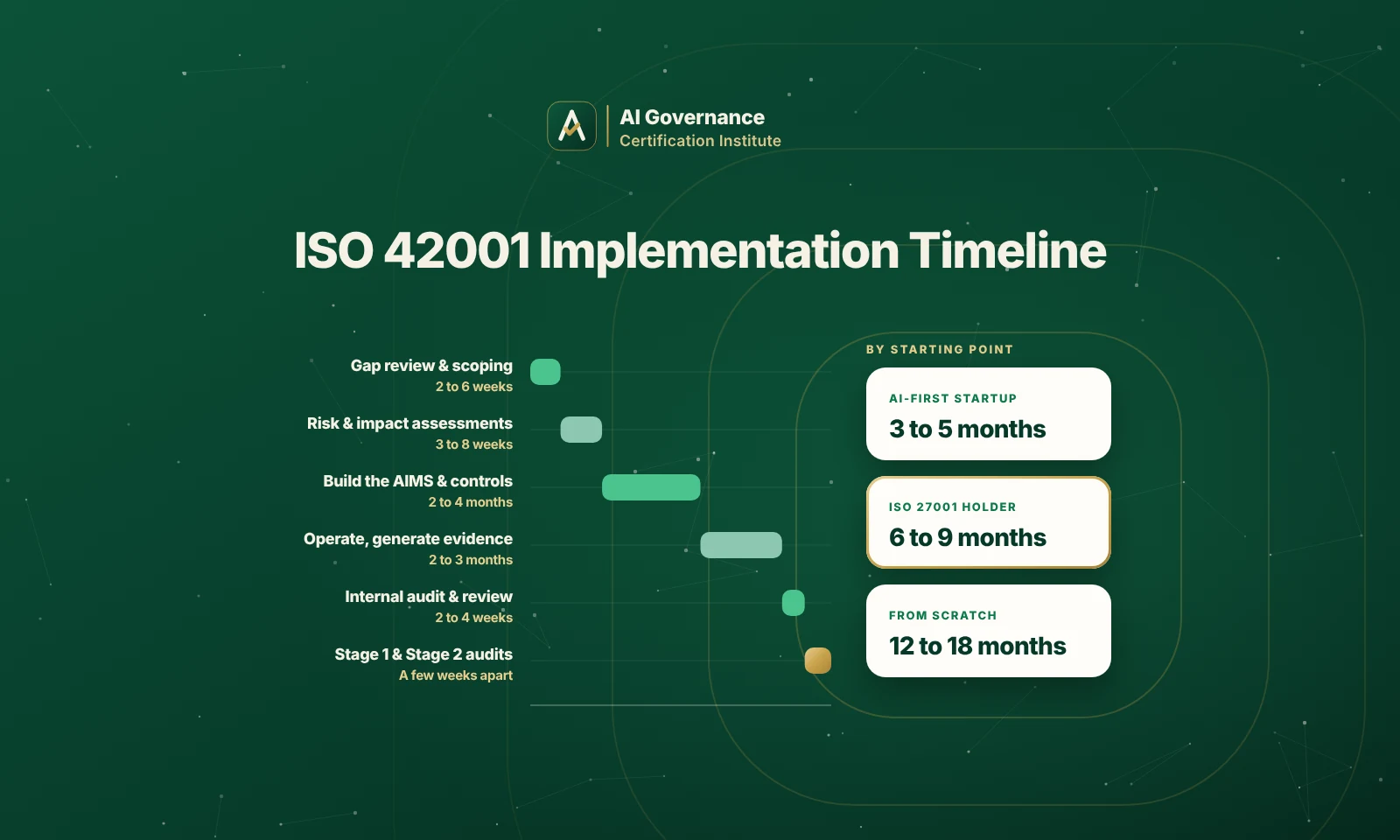
The whole implementation breaks into six phases. The table gives a realistic duration for each and, more usefully, what actually decides where you fall in the range. It begins with the gap analysis, the phase that scopes everything after it.
|
Phase |
Typical Duration |
What Decides the Length |
|
Gap analysis and scoping |
2 to 6 weeks |
How well you already know your AI systems |
|
Risk and impact assessments |
3 to 8 weeks |
The number and sensitivity of systems in scope |
|
Building the AIMS and controls |
2 to 4 months |
Scope size and how much governance exists already |
|
Operating the AIMS for evidence |
2 to 3 months |
Fixed, because the controls must actually run |
|
Internal audit and management review |
2 to 4 weeks |
Readiness and leadership availability |
|
Certification audit, Stage 1 and Stage 2 |
A few weeks apart |
Your certification body's schedule |
Add the phases and the arithmetic explains the range. A lean, well-prepared company compresses the early phases and lands near three to five months; a complex one from a standing start stretches the build and the evidence period and runs past a year. Either way, the phases do not simply add back to back, because some overlap and one of them, the evidence window, refuses to compress.
The Phase That Eats the Clock: Building and Operating the AIMS
Two phases in the middle account for most of the elapsed time, and understanding why stops you from planning an impossible schedule.
Building the AI management system is the longest active phase because it is where the real decisions live: setting scope, assessing risks and impacts, selecting controls, and writing the records that describe them. The more AI systems in scope and the less governance already in place, the longer this runs.
The phase people forget is the quiet one after the build: operating the system long enough to produce evidence. An auditor does not certify a system that was switched on last week, because the controls have to have actually run. This operating window, usually two to three months, is largely fixed, and it is the single biggest reason a timeline cannot simply be shortened by adding people. The model is the same across management system standards such as ISO/IEC 27001, where certification tests a system in operation rather than on paper.
Three Realistic Timelines by Starting Point
Averages hide more than they reveal, because the same standard lands very differently depending on where a company begins. Three profiles cover most real situations.
The AI-First Startup: Roughly Three to Five Months
A small company with one AI product, a narrow scope, and some security controls already in place moves fastest. The gap is small, the risk picture is contained to one or two systems, and decisions do not wait on committees. The binding constraint is the evidence window, not the build, so the floor is set by how long the controls must operate rather than by the paperwork.
The Company Starting From Scratch: Roughly Twelve to Eighteen Months
A mid-size or larger company with many AI systems, a broad scope, and little existing governance is at the other end. Here the build phase stretches, the inventory alone can take weeks, and risk and impact work multiplies across systems. Leadership alignment and clear ownership become the pacing items, and a realistic plan accepts that the first year is mostly building and operating, with the audit near the end.
The ISO 27001 Holder: Roughly Six to Nine Months
A company that already runs a certified management system has the shortest honest path of the three that start with real scope. The scope statements, document control, internal audit, and management review machinery already exist, so the work is extending them to AI rather than building from zero. The savings are real but bounded, because the AI-specific risk, impact, and evidence work still has to be done fresh.
A Month-by-Month View of a Nine-Month ISO 42001 Project
To make the middle path concrete, here is a representative nine-month schedule for a company that already has some governance in place. It is an illustration rather than a promise, but it shows how the phases sequence and exactly where the fixed operating window falls.
|
Months |
Focus |
Milestone |
|
Month 1 |
Gap analysis and scope definition |
Scope agreed and remediation plan approved |
|
Month 2 |
AI risk and impact assessments |
Risk register and impact assessments drafted |
|
Months 3 to 4 |
Building the AIMS and controls |
Policy, Statement of Applicability, and procedures in place |
|
Months 5 to 6 |
Operating the system |
Evidence accumulating from controls that are running |
|
Month 7 |
Internal audit and management review |
Readiness confirmed by leadership |
|
Month 8 |
Stage 1 audit |
Documentation passed and findings closed |
|
Month 9 |
Stage 2 audit |
Certificate issued |
The point to read off the schedule is months five and six. That operating window is not idle time; it is when the system earns the evidence the audit will test. Pull it forward, skip it, or add people to it and there is simply nothing for the Stage 2 audit to examine, which is why the honest schedules all leave it in.
What Speeds the Timeline Up
Companies that finish near the fast end of their range tend to do the same handful of things, and all of them are choices rather than luck:
• Narrow the scope. Certifying one product or service instead of the whole company is the single biggest accelerator available.
• Reuse what you already run. Existing security and quality controls carry over, which is why ISO 27001 holders move faster.
• Name one owner. A single accountable lead keeps decisions moving instead of waiting on a committee.
• Start with structure. Mapped templates and trained people remove the blank-page delay, which is part of what makes what training includes worth front-loading.
• Book the auditor early. Accredited bodies have waiting lists, so scheduling the audit while you build avoids dead time at the end.
What Slows the Timeline Down
The delays are just as predictable, and naming them is the cheapest way to avoid them:
• Scope creep. Widening scope mid-build is the most common way a plan slips, because every added system multiplies the risk and evidence work.
• No clear owner. When responsibility is shared across a group, decisions and evidence both stall.
• Documenting ahead of doing. Writing records for controls that are not actually running leaves nothing real for the operating window to capture.
• Booking the audit late. A ready system waiting weeks for an available auditor is pure lost time.
• Underestimating the operating window. Planning as if the audit can follow the build immediately, then discovering the controls have no track record to show.
The Two Dates You Do Not Control: Evidence Window and Audit Scheduling
Most of the timeline is yours to shape, but two parts are not, and planning around them prevents an unpleasant surprise at the end.
The first is the operating window. The controls must run long enough to generate evidence, and no amount of resourcing collapses that period, which is why a credible plan treats it as fixed. The second is the certification body's calendar. Accredited auditors are in demand, and the gap between the Stage 1 and Stage 2 audits is itself usually a few weeks to a couple of months and should not exceed six months, or Stage 1 must be repeated. Both are reasons to work backward from the audit date rather than forward from today.
How the Timeline Fits With Cost and the Roadmap
Time and money move together, since the longest phases are also where most of the spend sits, in internal effort rather than audit fees. The full breakdown of cost and timeline sets the two side by side, so a board can see the trade between a faster, tighter scope and a broader, slower one. Read against the stages in the roadmap, the timeline becomes a plan rather than a guess.
Frequently Asked Questions
How Long Does ISO 42001 Implementation Take?
For most companies, three to twelve months. A focused startup with a narrow scope can reach three to five months, a company starting from scratch across a broad scope typically needs twelve to eighteen, and an organization already certified to ISO 27001 usually lands around six to nine. The biggest single factor is the time the controls must operate before the audit.
Can a Company Get Certified in Three Months?
It is possible but only in a specific case: a small company, a tightly scoped single system, existing security controls, a dedicated owner, and an auditor booked early. Even then, the mandatory operating window for evidence sets the floor, so three months is realistic only when almost everything else is already in place.
Does Holding ISO 27001 Make ISO 42001 Faster?
Yes, usually by several months. The shared management system structure means the scope, document control, internal audit, and management review machinery already exist, so the work is extending them to AI. That commonly brings the timeline down to six to nine months, though the AI-specific risk and evidence work still has to be done.
What Is the Longest Phase of Implementation?
Building the AI management system, followed closely by the operating window that produces evidence. Together these two phases account for most of the elapsed time, which is why companies that try to compress the schedule by adding people are often disappointed: the evidence period does not shrink with headcount.
How Long Is the Gap Between the Stage 1 and Stage 2 Audits?
Commonly a few weeks to a couple of months, which gives you time to close any Stage 1 findings before the operational audit. It should not stretch beyond six months, or the Stage 1 audit has to be repeated, so this gap is worth planning into the schedule rather than discovering late.
How Far Ahead Should We Start if We Have a Compliance Deadline?
Work backward, not forward. Take the deadline, subtract the certification body scheduling lead time and the Stage 1 to Stage 2 gap, then the mandatory operating window, and only then the build. For a company starting with little governance that usually means beginning twelve to eighteen months out; for one with an existing management system, six to nine. Starting late is the one delay that no amount of effort later can recover.
Plan the Timeline, Then Build to It
A realistic timeline is the difference between a certification plan a board approves and one it quietly abandons. The companies that hit their dates are the ones whose people know which phases are fixed, which are flexible, and what evidence each one must leave behind. That judgment is what structured training builds, and you can see every route through the ISO 42001 courses, with the implementer path taught clause by clause in the Lead Implementer certification.