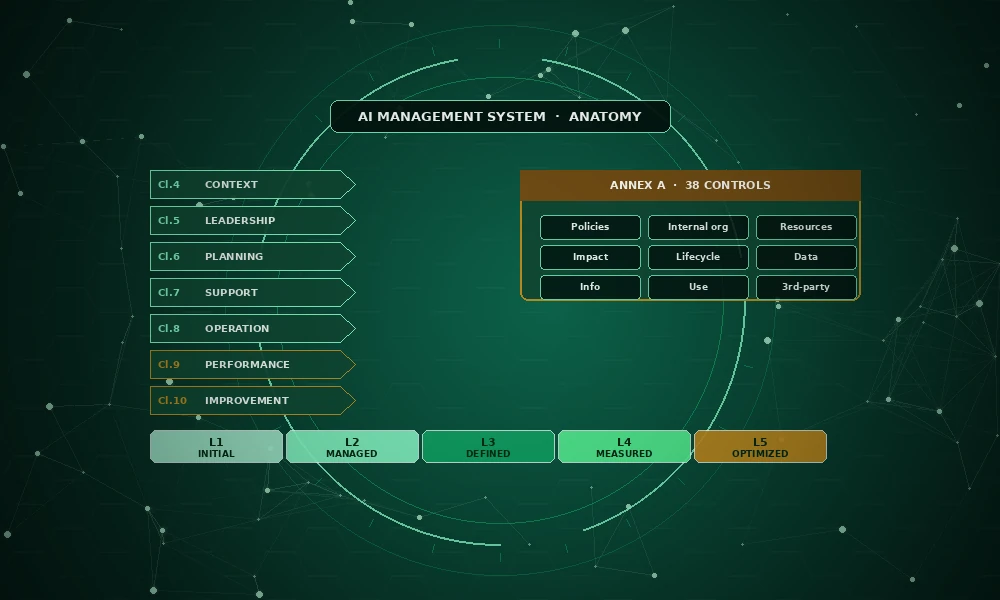
In December 2023, the International Organization for Standardization published ISO/IEC 42001, the world’s first management system standard written specifically for artificial intelligence. That single act gave a scattered field a shared reference point. For the first time, organizations had an agreed answer to the question of what good AI governance actually looks like as a system. The answer has a name, an AI Management System, or AIMS, and this page explains what it is, what it contains, and how you build one.
An AI Management System is the organized set of policies, roles, processes, and controls a company uses to govern how it develops, buys, deploys, and monitors AI. ISO/IEC 42001 defines it precisely as a “set of interrelated or interacting elements of an organization to establish policies and objectives, and processes to achieve those objectives,” applied to the use of AI. In plainer terms, an AIMS is the machinery that turns a good intention, using AI responsibly, into something you can run, evidence, and improve week after week.
If you have met ISO 27001 for information security or ISO 9001 for quality, the shape will feel familiar. An AIMS does for AI risk what those standards do for their domains, making governance repeatable instead of heroic. It is the model taught and certified by the AI Governance Certification Institute (AIGCI), and it is worth understanding well before you commit resources to it.
An AIMS turns AI governance into a running system, not a one-off project
Most organizations start governing AI reactively. A model does something unexpected, a customer asks an awkward question, or a regulator sends a letter, and someone scrambles to respond. An AIMS replaces that pattern with a standing capability. The management system defines who owns AI decisions, what rules apply, how risks get assessed, and how the whole thing gets checked and corrected over time.
The distinction matters because AI risk does not sit still. A model that behaves well at launch can drift as data changes, as people use it in ways you never intended, or as the model itself is updated. A project ends, but a management system keeps operating. That is why the standard frames an AIMS around continual improvement rather than a fixed checklist. The goal is a governance capability that adapts as your AI footprint grows.
An AIMS also gives AI governance an organizational home. Instead of responsibility floating between data science, legal, security, and product, the system assigns it. A named owner holds the AI policy at its core; defined roles carry risk assessment, impact assessment, and monitoring; and leadership reviews performance on a schedule. Governance becomes a standing function rather than a personal favour.
ISO/IEC 42001 defines the AIMS and sets its requirements
The AIMS is the concept, and the ISO 42001 standard is the specification that makes it concrete. ISO/IEC 42001:2023 states the requirements an organization must meet to establish, implement, maintain, and continually improve an AIMS, and it is the standard against which an organization can be independently certified.
Two design choices in the standard shape everything about how an AIMS works.
First, ISO 42001 uses the harmonized structure (Annex SL) shared by ISO 9001, ISO 14001, ISO/IEC 27001, and ISO 45001. Because the top-level clauses are common across these standards, an organization already certified to ISO 27001 can integrate an AIMS into its existing management system rather than building a parallel one. Shared context, leadership, planning, and audit machinery reduce duplication, which is a practical reason AI governance often grows out of an existing security program.
Second, the standard runs on the Plan-Do-Check-Act (PDCA) cycle, the same continuous-improvement loop behind other ISO management systems. You plan (understand context, set policy and objectives, assess risk), do (operate controls, run impact assessments, manage the AI lifecycle), check (monitor, measure, audit internally), and act (correct problems and improve). The cycle is what keeps an AIMS current instead of frozen at its launch state.
The AIMS lives in Clauses 4 to 10
The requirements of ISO 42001 are organized into numbered clauses. Clauses 1 to 3 cover scope, references, and definitions. The management system you actually build lives in Clauses 4 through 10, which map onto the PDCA cycle.
|
Clause |
Requirement in plain terms |
PDCA stage |
|---|---|---|
|
4: Context |
Understand your organization, interested parties, and the scope of your AIMS |
Plan |
|
5: Leadership |
Top management commits, sets the AI policy, and assigns roles |
Plan |
|
6: Planning |
Assess AI risks and opportunities, set objectives, and plan actions |
Plan |
|
7: Support |
Provide resources, competence, awareness, communication, and documentation |
Do |
|
8: Operation |
Run the AIMS: risk assessment, AI impact assessment, and lifecycle controls |
Do |
|
9: Performance evaluation |
Monitor, measure, audit internally, and hold management review |
Check |
|
10: Improvement |
Address nonconformities and continually improve the system |
Act |
This is the spine of any AIMS. Everything else, from policies and registers to assessments and controls, hangs off these seven clauses.
Annex A gives an AIMS its AI-specific controls
The clauses tell you to manage AI risk. The Annex A controls tell you what governing AI specifically involves. Annex A is a reference set of 38 controls grouped under 9 control objectives. During planning, you assess your risks, then select and justify which controls apply, using the same “statement of applicability” logic that ISO 27001 practitioners already know.
The nine control objectives map the territory an AIMS must cover:
-
AI policy: direction and rules for responsible AI, owned and maintained.
-
Internal organization: roles, responsibilities, and reporting lines for AI.
-
Resources for AI systems: accounting for data, tooling, compute, and human oversight.
-
AI system impact assessment: evaluating effects on individuals, groups, and society before deployment.
-
AI system life cycle: governing design, development, testing, deployment, and retirement.
-
Data for AI systems: provenance, quality, and appropriate handling of training and operational data.
-
Information for interested parties: telling users and affected parties what they need to know.
-
Responsible use of AI: ensuring AI is used within defined, acceptable bounds.
-
Third-party relationships: managing suppliers, vendors, and the AI you buy rather than build.
Two annex features are worth naming because they show the standard is built to be used, not only read. Annex B provides implementation guidance for each control, and Annex C offers a catalogue of AI-related objectives and risk sources that you can draw on when setting your own. An AIMS does not ask you to invent AI risk categories from scratch. The standard hands you a well-considered baseline to adapt.
The core building blocks of an AIMS
Reduced to its working parts, an AIMS is a small number of interlocking elements. Seeing them together makes the system less abstract.
|
Building block |
What it does |
Where ISO 42001 anchors it |
|---|---|---|
|
AI policy |
States the organization’s commitments and rules for responsible AI |
Clause 5 and Annex A objective A.2 |
|
Roles and accountability |
Assigns ownership for AI decisions, risk, and oversight |
Clause 5 and Annex A objective A.3 |
|
AI risk assessment |
Identifies and evaluates risks from AI systems |
Clauses 6 and 8 |
|
AI impact assessment |
Evaluates effects on individuals, groups, and society |
Clause 8 and Annex A objective A.5 |
|
AI system inventory |
Knows what AI you run, build, or buy, and its risk level |
Clause 8 and lifecycle controls |
|
Controls |
The safeguards selected from Annex A to treat risk |
Clause 6 and Annex A |
|
Monitoring and internal audit |
Checks the system works and surfaces problems |
Clause 9 |
|
Management review and improvement |
Leadership reviews performance and drives correction |
Clauses 9 and 10 |
None of these stands alone. The policy sets direction, roles make it someone’s job, assessments find the risks, controls treat them, monitoring catches drift, and management review closes the loop back to policy. That interconnection, rather than any single document, is what makes it a system.
Who owns and operates an AIMS?
Those building blocks work only when each one has an owner. An AIMS assigns responsibility deliberately, so that policies stay current, assessments actually happen, and controls are operated rather than merely documented. The work is shared across leadership, governance, risk, and audit roles, each accountable for a specific part of the system. Mapping these responsibilities early, often in a simple AI governance RACI matrix, is one of the fastest ways to move from good intentions to a system that runs.
|
AIMS activity |
Responsible role |
What the role is accountable for |
|---|---|---|
|
AI governance direction |
Top management or AI governance committee |
Sets objectives, approves the AI policy, and reviews performance (Clause 5) |
|
AI policy |
AI governance lead |
Maintains the responsible-AI rules and the governance process |
|
AI inventory |
AI system owners |
Track each AI system with its use, ownership, and lifecycle |
|
AI risk assessment |
AI risk manager or GRC team |
Identifies and evaluates AI risks (Clause 6) |
|
AI impact assessment |
AI governance or compliance team |
Assesses effects on people, groups, and society (control A.5) |
|
Annex A controls |
AIMS implementation team |
Selects, justifies, and operates the chosen controls |
|
Third-party AI |
Procurement or vendor-risk team |
Assesses and monitors AI suppliers |
|
Internal audit |
Internal auditor |
Evaluates whether the AIMS works as intended (Clause 9) |
|
Improvement |
Leadership with the AIMS owner |
Reviews findings and improves the system (Clause 10) |
No single job title matters as much as the principle behind the table. Every part of the AIMS has one clear owner, so nobody has to guess who acts when something needs attention. With responsibilities mapped this way, you can judge honestly how far your own system has matured.
The AIMS Maturity Model: where does your organization actually stand?
Most guides hand you a checklist. A checklist tells you what to do but not where you stand, and where you stand is the question owners actually ask. The AIMS Maturity Model below maps the honest stages organizations move through, the observable signals of each stage, the dominant risk, and the single most useful next move. Locate yourself by the signals rather than by ambition, because most organizations sit a stage lower than they would guess.
|
Stage |
What you would observe |
Dominant risk at this stage |
Highest-value next move |
|---|---|---|---|
|
0: Unaware |
AI is used across teams with no inventory, no owner, and no policy |
Invisible risk, because you cannot govern what you have not counted |
Build an AI inventory and name a single accountable owner |
|
1: Reactive |
AI risk is handled case by case when something goes wrong |
Governance depends on individuals noticing, so it does not scale |
Draft an AI policy and define who decides what |
|
2: Defined |
An AI policy exists, roles are assigned, an inventory is maintained |
Rules on paper outrun rules in practice |
Start structured AI risk and impact assessments on live systems |
|
3: Managed |
Assessments are routine, Annex A controls are operating, internal audits run |
Consistency across teams and suppliers, and evidence gaps |
Run a full internal audit and management review against ISO 42001 |
|
4: Optimized |
The AIMS is certified, metrics-driven, and improving through the PDCA cycle |
Complacency, and drift as the AI estate and regulation change |
Feed audit findings and incidents back into policy and objectives |
The model is about judgement rather than box-ticking. An organization with a polished policy but no live risk assessments sits at Stage 2, not Stage 3, because the document exists while the system is not yet operating. Reading yourself honestly against the “dominant risk” column tends to be more clarifying than the stage label itself.
A quick readiness self-check
If you are deciding whether you are ready to pursue an AIMS or certification, these symptoms point to where the gap sits. Each one maps to a part of the system, so a “yes” tells you exactly where to start.
|
If this is true today |
It signals a gap in |
Start with |
|---|---|---|
|
No one can list all the AI systems you use |
AI inventory and lifecycle |
An inventory and system owners |
|
Nobody owns the final call on AI risk |
Leadership and roles (Clause 5) |
An AI policy and accountability map |
|
You assess models for accuracy but not for societal impact |
Impact assessment (A.5) |
An AI impact assessment process |
|
Vendors supply AI but you have not reviewed how they govern it |
Third-party relationships |
Supplier due-diligence controls |
|
You launched governance once and never revisited it |
Monitoring and improvement (Clauses 9 and 10) |
An internal audit and management review cycle |
Why organizations build an AIMS now
Adoption has moved from early adopters toward the mainstream. Across 2024 and 2025, major technology firms certified their AI services to ISO 42001. AWS achieved accredited certification for services that include Amazon Bedrock and Amazon Q Business, Microsoft certified Azure AI Foundry Models and Microsoft Security Copilot, and KPMG International became the first of the Big Four’s international entities to attain the certification. An AIMS is becoming a normal expectation in enterprise AI procurement rather than a rare differentiator.
Regulation is the other driver. The EU AI Act entered into force with a phased timeline: prohibited practices applied from February 2025, obligations for general-purpose AI models from August 2025, and many high-risk system requirements from August 2026. An AIMS gives organizations a systematic, auditable way to operationalize obligations like these. One point deserves precision. ISO/IEC 42001 is not yet a harmonized standard under the EU AI Act, so certification does not grant an automatic “presumption of conformity,” and a dedicated European standard (prEN 18286) is in development to cover the Act’s full requirements. What an AIMS does provide is the operating structure, meaning the policies, assessments, controls, and evidence, that makes demonstrating compliance far more manageable when the rules apply to you.
For most organizations, the honest reason to build an AIMS is simpler than either adoption pressure or regulation. It is the difference between hoping your AI is being used responsibly and being able to show it. An AIMS is how you earn that confidence, and you can start building it at any maturity stage.
The AIMS Maturity Model
A quick, honest way to locate where your organization stands on the road to an ISO/IEC 42001 AI Management System, and the single most useful next move at each stage.
How to use it
Find the row whose “What you would observe” description best matches your organization today. Read by the observable signals, not by ambition; most organizations sit a stage lower than they expect. An organization with a written policy but no live risk assessments is Stage 2, not Stage 3, because the document exists while the system is not yet operating. Your highest-value next move is in the final column.
|
Stage |
What you would observe |
Dominant risk at this stage |
Highest-value next move |
|---|---|---|---|
|
0: Unaware |
AI is used across teams with no inventory, no owner, and no policy |
Invisible risk, because you cannot govern what you have not counted |
Build an AI inventory and name a single accountable owner |
|
1: Reactive |
AI risk is handled case by case when something goes wrong |
Governance depends on individuals noticing, so it does not scale |
Draft an AI policy and define who decides what |
|
2: Defined |
An AI policy exists, roles are assigned, an inventory is maintained |
Rules on paper outrun rules in practice |
Start structured AI risk and impact assessments on live systems |
|
3: Managed |
Assessments are routine, Annex A controls are operating, internal audits run |
Consistency across teams and suppliers, and evidence gaps |
Run a full internal audit and management review against ISO 42001 |
|
4: Optimized |
The AIMS is certified, metrics-driven, and improving through the PDCA cycle |
Complacency, and drift as the AI estate and regulation change |
Feed audit findings and incidents back into policy and objectives |
Readiness self-check
If any statement below is true today, it points to the part of the system to build next.
|
If this is true today |
It signals a gap in |
Start with |
|---|---|---|
|
No one can list all the AI systems you use |
AI inventory and lifecycle |
An inventory and system owners |
|
Nobody owns the final call on AI risk |
Leadership and roles (Clause 5) |
An AI policy and accountability map |
|
You assess models for accuracy but not for societal impact |
Impact assessment (A.5) |
An AI impact assessment process |
|
Vendors supply AI but you have not reviewed how they govern it |
Third-party relationships |
Supplier due-diligence controls |
|
You launched governance once and never revisited it |
Monitoring and improvement (Clauses 9 and 10) |
An internal audit and management review cycle |
Frequently asked questions
What does AIMS stand for?
AIMS stands for Artificial Intelligence Management System. It is the organized set of policies, roles, processes, and controls an organization uses to govern its development, procurement, deployment, and monitoring of AI. ISO/IEC 42001 is the international standard that defines what an AIMS must contain.
Is an AIMS the same as ISO 42001?
Not quite. An AIMS is the management system itself, the thing you build and operate. ISO/IEC 42001 is the standard that specifies the requirements for that system and the benchmark you can be certified against. You build an AIMS, and you certify it to ISO 42001.
How is an AIMS different from an information security management system (ISMS)?
An ISMS (ISO/IEC 27001) governs information security risk, while an AIMS (ISO/IEC 42001) governs AI-specific risk such as bias, transparency, human oversight, and societal impact. Because both use the same harmonized ISO structure, an organization with an ISMS can integrate an AIMS into it rather than starting over, which is why AI governance often grows out of an existing security program.
Do we need ISO 42001 certification to have an AIMS?
No. You can build and operate an AIMS without pursuing certification, and many organizations do exactly that to get governance working first. Certification by an accredited body adds independent, third-party assurance that your AIMS meets the standard. That is valuable for customers, regulators, and procurement, though it is a separate step from having the system.
Who is responsible for an AIMS in an organization?
Accountability sits with top management, who set direction and approve the AI policy, but the day-to-day work is shared. A governance lead maintains the policy, system owners keep the AI inventory, risk and compliance teams run assessments, an implementation team operates the Annex A controls, and an internal auditor checks that the system works. The roles table above shows how these responsibilities fit together.
What are the first steps to building an AIMS?
Begin by inventorying the AI systems you use, build, or buy, and naming a single accountable owner. From there, draft an AI policy, define roles, and start assessing the risks and impacts of your live systems. Those steps move most organizations from an ad hoc state into a defined, governable one, and they map directly onto Clauses 4 to 6 of ISO 42001.
Building your AIMS from here
An AI Management System is, at heart, a simple idea carried out with discipline. You decide how your organization should govern AI, assign someone to own it, assess the risks, put controls in place, and check and improve the whole thing on a cycle. ISO/IEC 42001 gives that idea a precise specification, a familiar structure, and a set of AI-specific controls, so you are adapting a proven blueprint rather than inventing one.
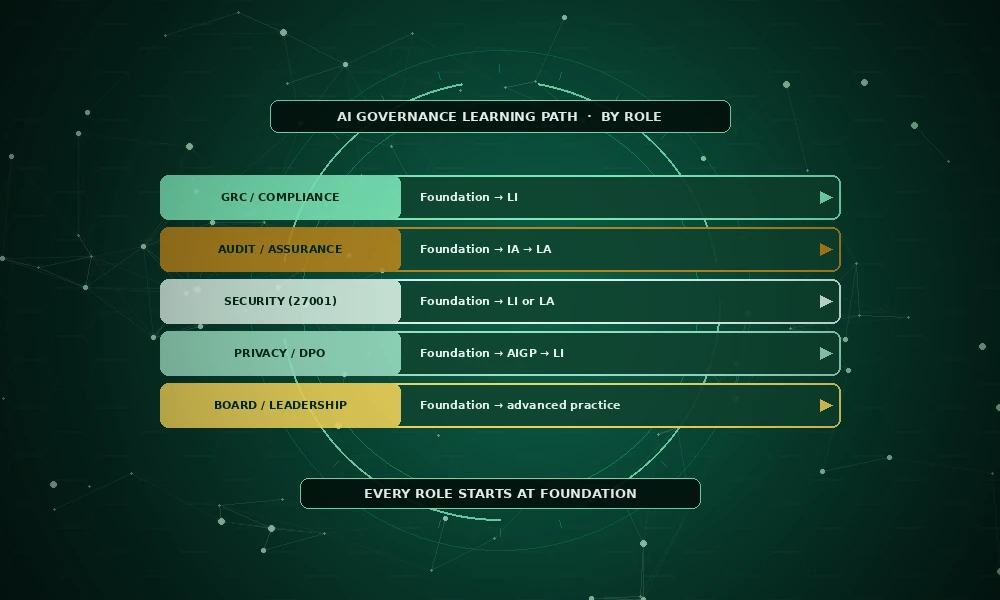
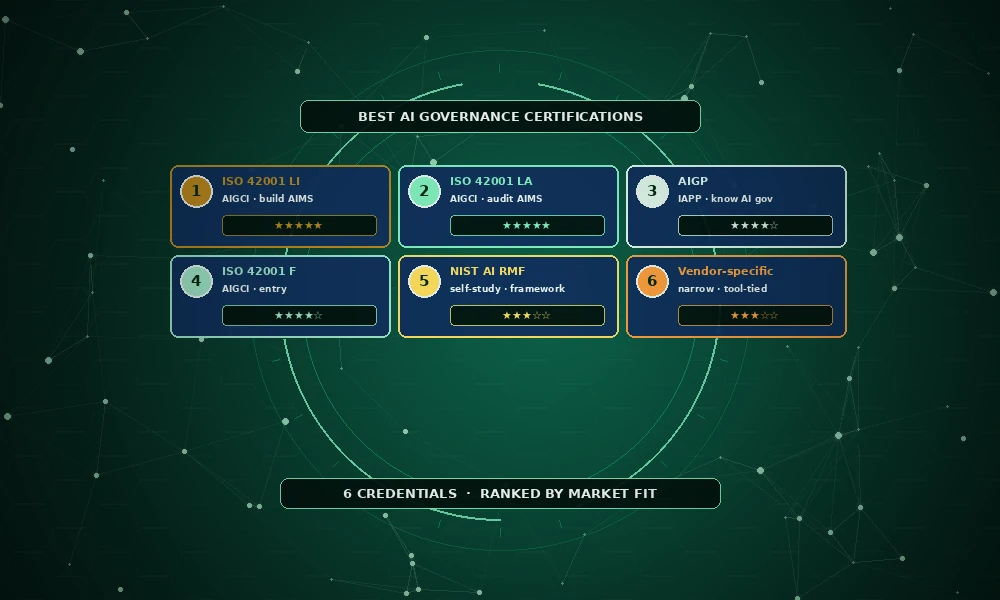
Wherever you sit on the maturity model, the next move is concrete and within reach. The people who lead this work well tend to share one quality: they understand the standard deeply enough to apply judgement rather than merely follow steps. Building that depth is what training is for. Study for the ISO 42001 Foundation certification to gain a working grasp of the standard, then move toward the ISO 42001 Lead Implementer certification when you are ready to build and run the AIMS yourself.