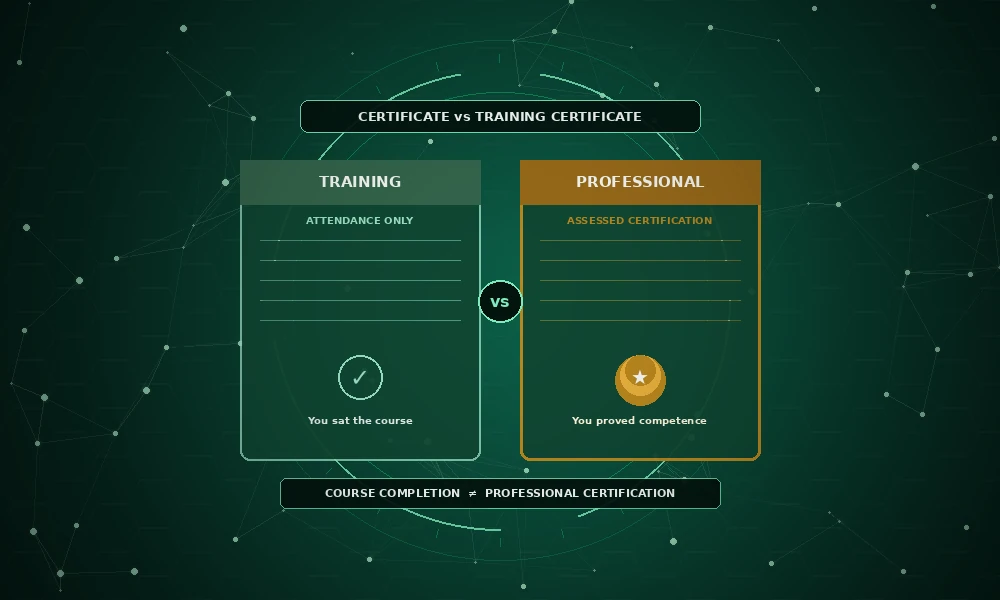
Only about half of employers independently verify the credentials a candidate lists, according to SHRM, which means the responsibility for understanding what a certificate actually proves increasingly sits with you. That matters here because two very different documents get called an ISO 42001 certificate. One is a training or attendance certificate, which shows you sat through a course. The other is a professional certification, which shows you passed an independent assessment of your competence. They look similar on a wall. They are not the same thing, and treating one as the other is where people get caught out. The AI Governance Certification Institute (AIGCI) built this guide to make the difference unmistakable.
A training certificate proves you attended or completed a course; a professional certification proves you passed an independent, assessed examination of your competence. Only the second is a certification.
Why a training certificate is not a certification
The cleanest way to remember it: a certificate is issued for completing something, while a certification is awarded for proving something. A training provider can hand you a certificate the moment a course ends, based on attendance. A certification, by contrast, is governed by ISO/IEC 17024, the international standard for certifying people, operated by bodies that can be independently accredited by an accreditation body such as ANAB. Under that standard a certification must be job-role based, assessed through a secure and impartial exam, and maintained over time. A training provider sits outside that system of accredited certification of persons. In fact ISO/IEC 17024 does not even apply to a plain certificate of attendance or completion, which is the clearest signal that the two belong in different categories.
How the two documents compare, side by side
Set them next to each other and the differences are not subtle. This comparison covers what each one is, how you get it, and what it lets you claim.
|
Dimension |
Professional certification |
Training or attendance certificate |
|---|---|---|
|
What it proves |
Assessed competence for a role |
That you attended or completed a course |
|
How you earn it |
Pass an independent exam |
Show up and finish the training |
|
Who issues it |
A certification body |
A training provider |
|
Assessment |
Secure, impartial examination |
Often none, or an informal quiz |
|
Governing standard |
ISO/IEC 17024 |
No certification standard |
|
Ongoing upkeep |
Renewed through continuing development |
None once issued |
|
Honest claim |
'Certified' in the role |
'Completed training in' the topic |
Three documents people call an ISO 42001 certificate
Adding to the confusion, there is a third document in the mix. When someone says ISO 42001 certificate, they could mean any of three things, and only two of them are certifications at all.
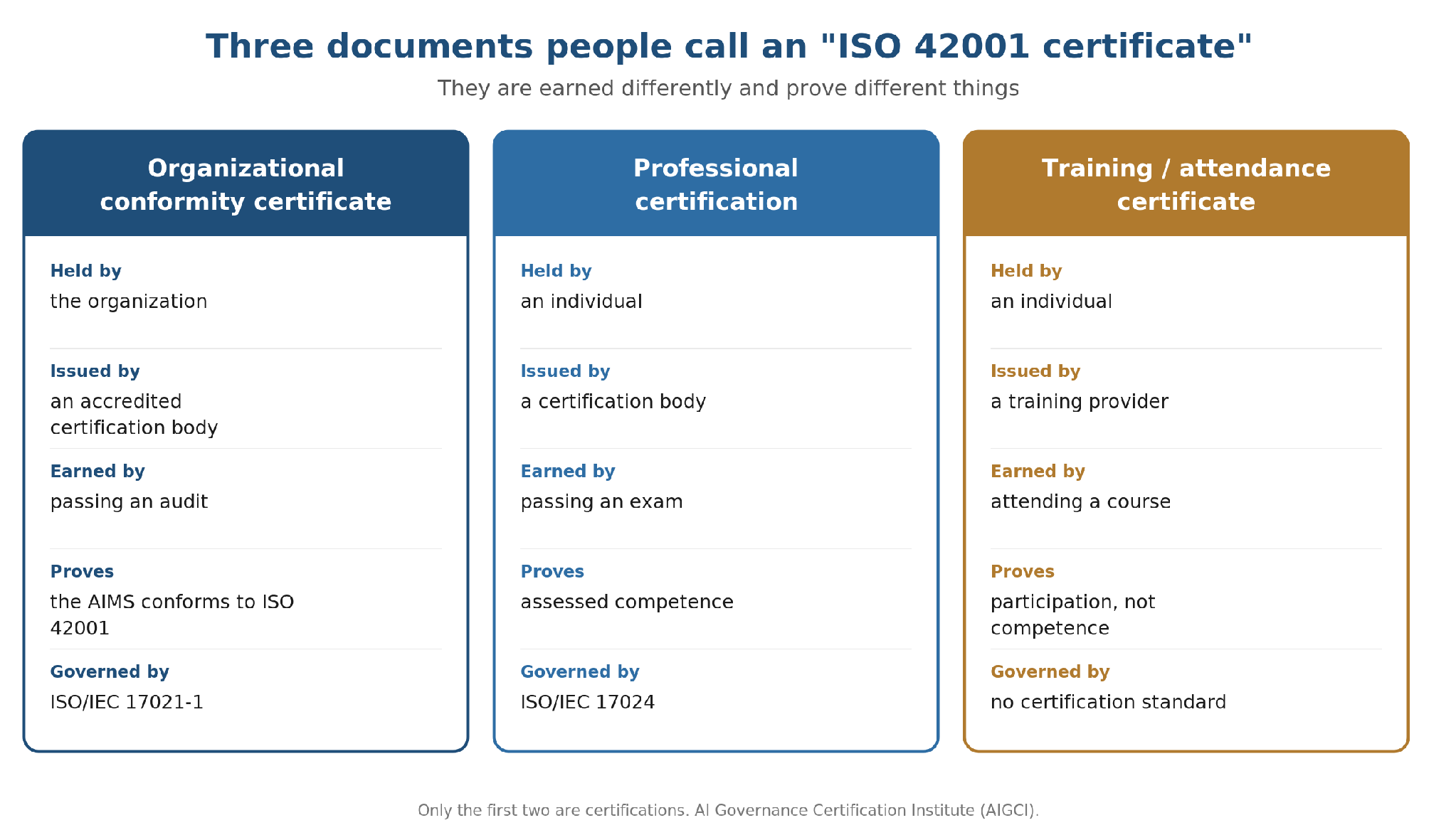
Figure 1. An organizational conformity certificate, a professional certification, and a training certificate are earned differently and prove different things.
The organizational conformity certificate is what an organization earns when an accredited body audits its AI management system against the standard, under ISO/IEC 17021-1. The professional certification is what an individual earns by examination. The training certificate is neither an audit outcome nor an exam result. Keeping these three apart is the single most useful habit when you read anyone's ISO 42001 claim, and it is why a real professional certification such as Lead Implementer is worth distinguishing from a course you simply attended.
How to describe what you actually hold, honestly
Because verification is rising, precise wording protects you. Claiming to be certified when you hold only a training certificate is the kind of overstatement a background check now catches. Say what is true, and it will always hold up.
|
If you hold this |
Describe it like this |
|---|---|
|
A completed training course |
Completed ISO 42001 [level] training |
|
A passed professional exam |
Certified ISO 42001 [Lead Implementer or similar] |
|
Your employer's audited certificate |
Our organization is ISO 42001 certified |
|
A webinar or short awareness session |
Attended ISO 42001 awareness training |
How to spot the difference on any certificate
You can classify almost any ISO 42001 document in under a minute by asking four questions. Was there an independent exam, or just attendance? Does it name a certification body, or a training provider? Does it reference ISO/IEC 17024, an accreditation, or a certificate number you can check? Does it expire and require renewal, or is it a one-time keepsake? Exam, certification body, accreditation, and renewal all point to a genuine certification. Attendance, a training provider, and no expiry point to a training certificate.
This also explains why checking whether it is recognised is the natural next step: recognition applies to certifications backed by accreditation, not to course-completion slips. In short, a training certificate records what you attended, a professional certification records what you proved, and an organizational certificate records what your company was audited against. Name each one correctly and the whole picture becomes clear.
Frequently asked questions
Does a training certificate make me ISO 42001 certified?
No. A training certificate shows you completed a course. Being certified means you passed an independent, assessed examination governed by ISO/IEC 17024. The honest description of a course is that you completed training, not that you are certified.
Is a course-completion certificate worthless then?
Not at all. It is real evidence that you learned the material, and it is often the right first step. It simply is not a certification, so it should be described as training rather than as a credential you were assessed for.
How can I tell which one a provider is offering?
Ask whether there is an independent exam and whether the credential is issued by a certification body. If the document is issued at the end of a course for attendance, it is a training certificate. If it follows a secure exam, it is a professional certification.
Is the organization's ISO 42001 certificate the same as my personal one?
No. An organization earns a conformity certificate through an audit of its management system. An individual earns a professional certification through an exam. They are separate documents with separate purposes.
Which should I pursue?
Start with training to build knowledge, then pursue a professional certification if you want an assessed, recognised credential. Many people do both, in that order, and describe each accurately.
Earn a certification, not just a certificate
If your goal is a credential that stands up to scrutiny, choose an assessed route. AIGCI's exam-based ISO 42001 certifications are built around independent assessment, so what you earn is a certification you can describe as one without hesitation. To see how the institute structures its programme, read more about the institute.