Yes, with one important condition. ISO/IEC 42001 is an international standard developed by the International Organization for Standardization and the IEC, so it is recognised worldwide as the benchmark for AI management. What decides whether a specific certificate is globally recognised is not the standard, but the accreditation behind the certification body that issued it. An accredited certificate carries weight across markets through the international mutual-recognition system for accredited certification; an unaccredited or self-issued one does not. The AI Governance Certification Institute (AIGCI) exists to help you understand that difference, because it is the difference between a certificate that travels and one that stops at your own front door.
ISO 42001 certification is globally recognised when it is issued by an accredited certification body, because accreditation connects the certificate to an international arrangement in which conformity assessed once is accepted everywhere.
Key facts at a glance
|
Question |
Short answer |
|---|---|
|
Is the standard global? |
Yes. ISO/IEC 42001 is an international standard applicable worldwide |
|
What drives recognition? |
Accreditation of the certification body, not the standard alone |
|
Who accredits certifiers? |
National accreditation bodies such as ANAB and UKAS |
|
How does one certificate travel? |
Through international mutual recognition of accredited certification |
|
Is accredited ISO 42001 available? |
Yes. Accredited certification became available through 2024 and 2025 |
|
What should you check? |
That the issuing body is accredited, and that the certificate is verifiable and valid |
What global recognition actually depends on
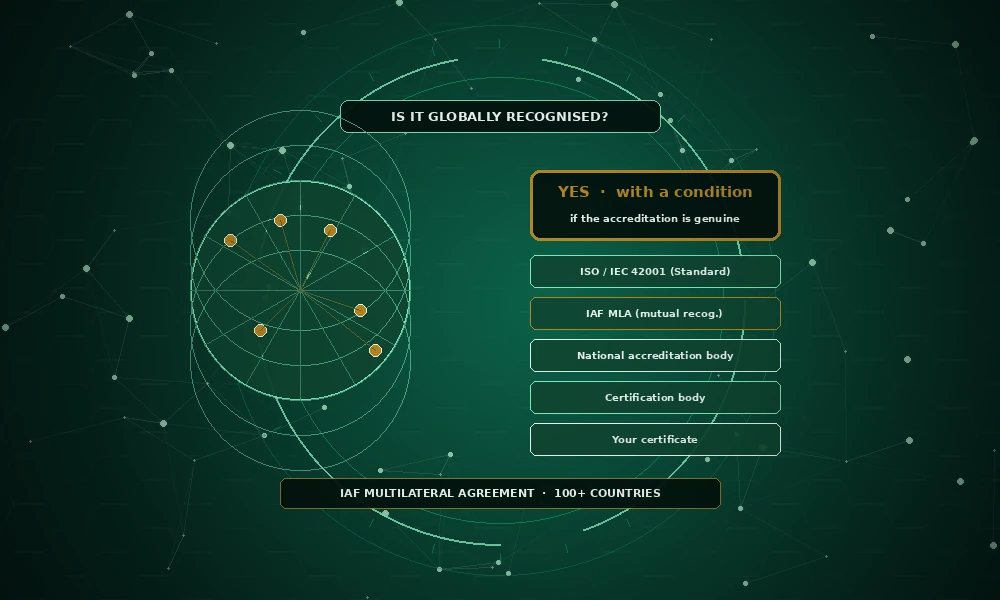
ISO does not certify anyone. It writes the standard, and it deliberately leaves certification and accreditation to a separate, independent chain. That chain is what gives a certificate its reach. A national accreditation body, such as ANAB in the United States or UKAS in the United Kingdom, assesses and accredits the certification bodies that audit organizations. Those accreditation bodies in turn take part in an international arrangement for mutual recognition, historically the IAF Multilateral Recognition Arrangement, whose principle is simple: certified once, accepted everywhere. So recognition does not come from the ISO logo on a certificate. It comes from the accreditation stamp behind it.
The chain of trust behind a recognised certificate
It helps to picture recognition as a chain. Each link passes trust down to the next, which is why a certificate is only ever as credible as the accreditation above it.
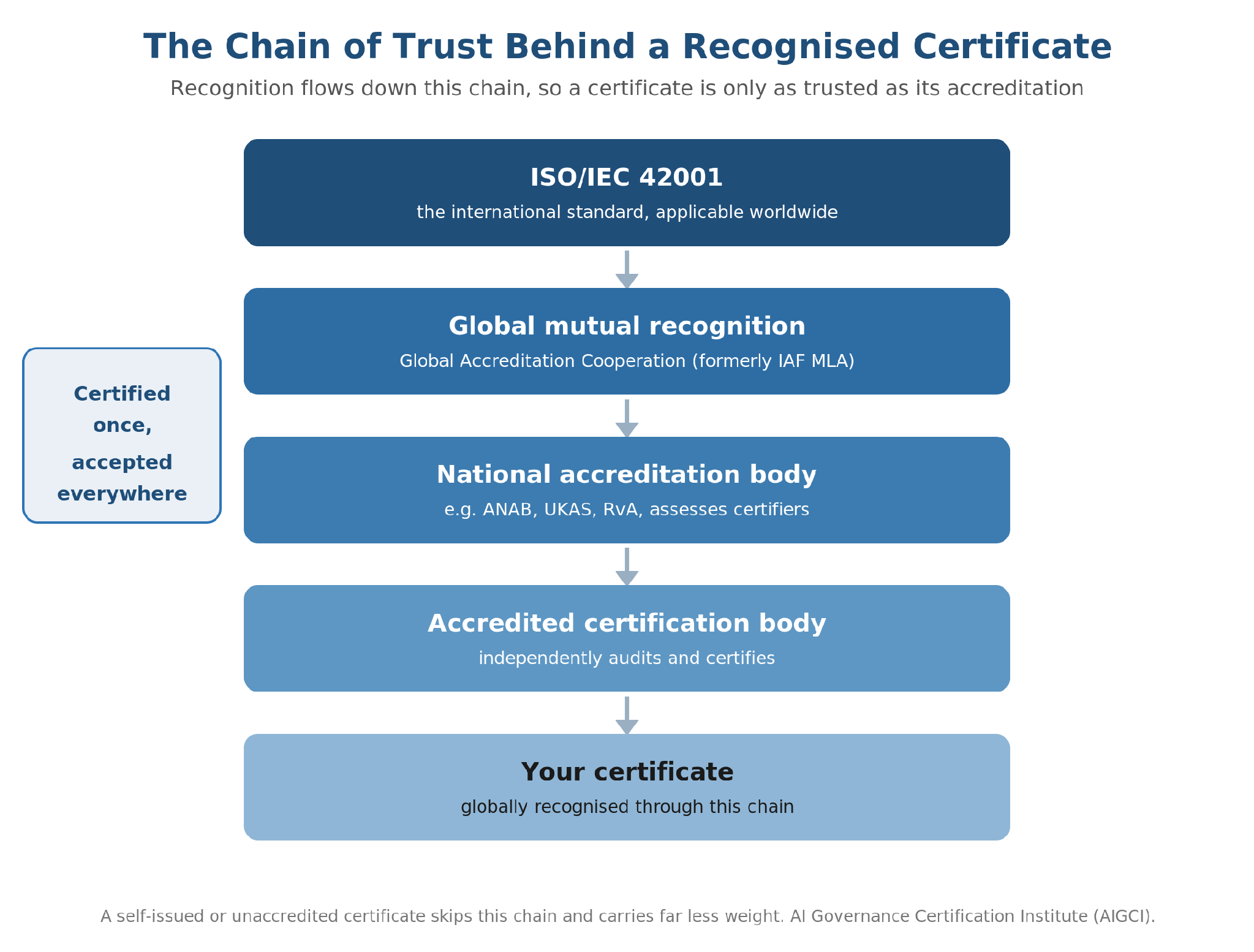
Figure 1. Recognition flows down a chain of trust from the international standard to your certificate.
The mutual-recognition network is genuinely global. In 2024 it linked 86 accreditation bodies across 100 economies. From 1 January 2026 this work continues under a new single body, the Global Accreditation Cooperation, which brings the former IAF and ILAC arrangements together, so the principle of one accredited certificate being accepted across borders carries forward unchanged. For the detail on the mark itself, see the accreditation behind it.
Why this matters more for ISO 42001 than for older standards
Because ISO/IEC 42001 only arrived in 2023, its accreditation ecosystem is younger than that of long-established standards. Accredited certification became available in stages: ANAB opened accreditation for AI management systems first, and UKAS granted its first ISO 42001 accreditation in late 2025. That timing has a practical consequence. In a young market, some organizations hold certificates from bodies that are not yet accredited, or attestations that look like certification but are not. Knowing to check accreditation is therefore more useful here than with a mature standard, where it is largely taken for granted.
How to be sure a certificate is recognised
Three checks settle it. First, confirm the certificate names an accredited certification body and shows the accreditation body's mark. Second, confirm the certificate is current, since recognition lapses when a certificate expires; our guide on how long it stays valid explains the cycle. Third, confirm the certificate is real by checking it against the issuer's or accreditation body's register; our walkthrough on how to verify a certificate shows exactly how. Pass all three and the certificate is globally recognised in the way that matters to customers, partners, and regulators.
In short, the standard is global by design, but a certificate earns global recognition through accreditation. Check that the issuer is accredited, that the certificate is valid, and that it can be verified, and an ISO 42001 certificate will be accepted wherever your organization does business.
Frequently asked questions
Is ISO 42001 recognised in every country?
The standard is international, so it is recognised worldwide as a benchmark. A certificate is accepted across borders when the issuing body is accredited by an accreditation body that takes part in the international mutual-recognition arrangement.
Does ISO issue or recognise certificates itself?
No. ISO writes the standard but does not certify organizations or accredit certifiers. Certification and accreditation are handled by independent bodies, which is what keeps the system impartial.
What is the difference between accredited and unaccredited certification?
An accredited certificate is issued by a body whose competence has been independently assessed, so it carries international recognition. An unaccredited or self-issued certificate has not been through that check and is treated with far more caution.
Is a professional ISO 42001 certification globally recognised too?
Professional certifications earned by individuals are recognised based on the reputation and rigour of the body that issues them, rather than through the same accreditation chain that applies to organizational certificates.
Is accredited ISO 42001 certification available now?
Yes. Accredited certification for AI management systems became available through 2024 and 2025 as national accreditation bodies opened their programmes, and the number of accredited certifiers continues to grow.
Certify with recognition in mind
Whether you are choosing a certification route or building the skills to run one, it pays to understand the accreditation chain first. AIGCI's ISO 42001 certification programmes ground you in how recognition works, from the standard through to audit, so the credential you pursue is one that holds up internationally. To learn how the institute approaches this, read more about the institute. You can also start from the basics with our overview of what ISO 42001 is.