Digital badges have gone mainstream: the number issued worldwide reached 320.4 million in 2025, up from 74.7 million three years earlier, according to 1EdTech's Badge Count. But a badge is only as trustworthy as what sits behind it. An ISO 42001 digital badge is a verifiable credential, a small package of data that proves who earned what, from whom, and against which criteria. Its real weight, though, comes from accreditation, the independent oversight that confers recognition on the certification the badge represents. The AI Governance Certification Institute (AIGCI) built this page to show how the badge and the accreditation work together, so you can tell a meaningful credential from a decorative one.
An ISO 42001 digital badge is a verifiable digital credential carrying embedded metadata, and accreditation is the independent oversight of the issuer that confers recognition on the certification behind it.
What makes a digital badge more than an image
A meaningful digital badge is not a picture you can copy from a website. Under the Open Badges standard maintained by 1EdTech, a badge carries rich metadata baked into the file itself: who issued it, who earned it, the criteria it was assessed against, the evidence behind it, and the dates it applies to. That metadata is what makes a badge machine-readable, portable across platforms, and independently verifiable. The distinction matters, because a plain image proves nothing, while a standards-based badge links back to a live, checkable record. The latest version, Open Badges 3.0, even aligns with the W3C Verifiable Credentials model used across digital identity, which is a sign of how seriously verifiable credentials are now taken.
Anatomy of a verifiable digital badge
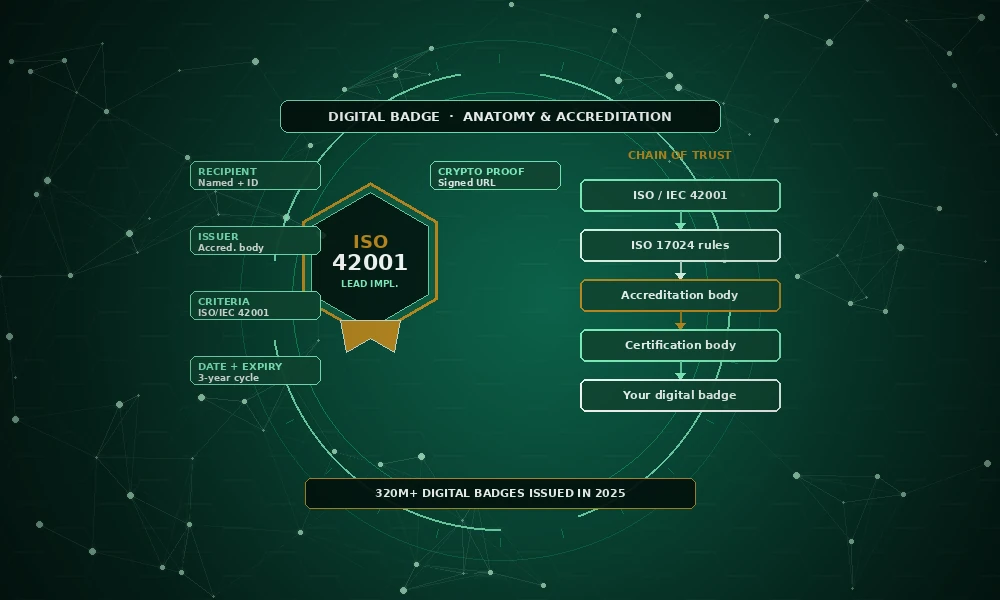
It helps to see what a trustworthy badge actually contains. The credential below is illustrative, but every field on it exists to answer a question a sceptical reader would ask.
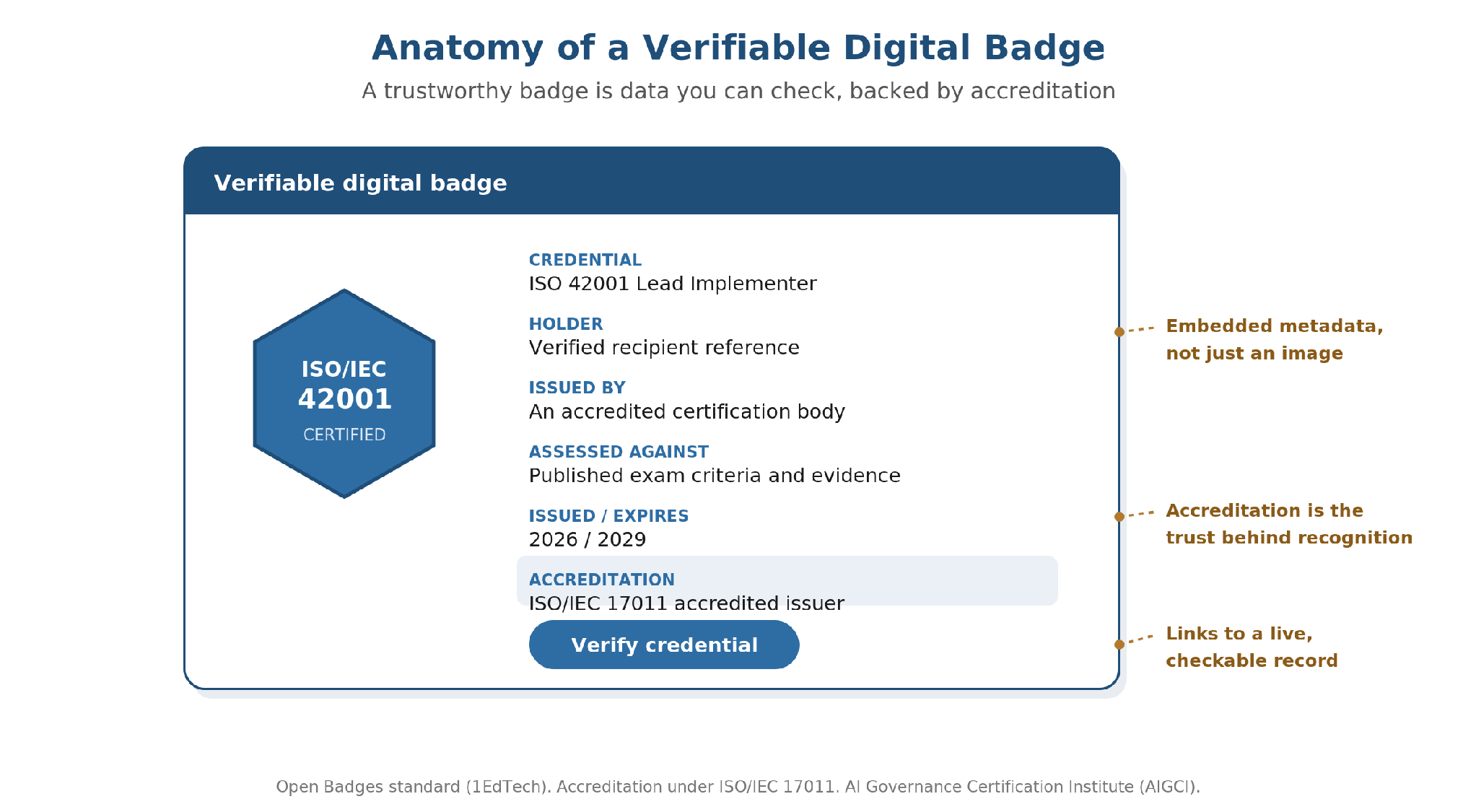
Figure 1. A verifiable digital badge carries embedded metadata and links to a checkable record, with accreditation as the trust behind it.
Read a badge and you should be able to see the credential name, the holder, the issuer, the criteria it was assessed against, the issue and expiry dates, and a way to verify it. If all a badge offers is a logo and a name, it is decoration. If it carries this metadata and links to a live record, it is a credential.
How accreditation confers recognition
A badge tells you what was earned; accreditation tells you whether the body that issued it can be trusted to say so. Accreditation bodies operate under ISO/IEC 17011, the international standard that sets requirements for their competence, consistency, and impartiality. Working to that standard, an accreditation body such as those described by ANAB independently assesses certification bodies to confirm they meet international requirements. That is the mechanism by which accreditation confers recognition: it is authoritative, third-party confirmation that the issuer is competent. And because accreditation bodies peer-evaluate each other under the same standard, an accredited credential is accepted internationally through the mutual-recognition arrangement, rather than only where it was issued.
How the badge and the accreditation connect
Put the two together and the picture is complete. The badge is the portable, verifiable evidence; the accreditation is the reason that evidence carries weight. A verifiable badge with no accreditation behind it proves only that a course was completed. An accredited certification with no digital badge is trustworthy but harder to share and check. The strongest credentials have both. This is why whether the certification is recognised and how to verify it are the natural companions to this page: recognition comes from the accreditation, and verification is how you confirm the badge leads back to it.
What to check on an ISO 42001 badge
Before you trust a badge, look for four things. Does it name the issuing body, and is that body accredited? Does it show the standard and the criteria it was assessed against? Does it carry issue and expiry dates? And does it link to a live record you can open, rather than a static image? A badge that passes all four is a credential you can rely on. In short, the badge makes a credential portable and checkable, and accreditation is what gives it authority, so look for both before you take any ISO 42001 claim at face value.
Frequently asked questions
Is a digital badge the same as a certificate?
A digital badge is a portable, verifiable representation of a credential. It can accompany a certificate, but its value comes from the metadata it carries and the accreditation behind the issuer, not from the image itself.
What is accreditation, in simple terms?
Accreditation is independent oversight of the body that issues a certification. Under ISO/IEC 17011, an accreditation body confirms that a certification body is competent and impartial, which is what gives its certificates recognition.
Does a badge prove a certification is accredited?
Only if the badge says so and links to a record you can check. A trustworthy badge names the issuer and its accreditation and leads to a live verification page. A badge with no such link should be treated with caution.
Why does accreditation matter for recognition?
Because recognition depends on trust in the issuer, and accreditation is how that trust is established and shared internationally. An accredited credential is accepted across borders through mutual-recognition arrangements between accreditation bodies.
Can I verify a badge myself?
Yes. Follow the badge to its source rather than trusting a screenshot, and confirm the issuer, the standard, the dates, and the accreditation. Our verification guide sets out the exact steps.
Earn a badge that stands for something
The credential worth holding is one that carries real metadata and real accreditation behind it. AIGCI's ISO 42001 certifications with a verifiable badge are designed so what you earn can be shared and checked, with the trust layer that makes a badge meaningful. To see how the institute approaches this, read more about the institute.