
Ask a chatbot to write your AI policy and it will hand you a full draft in under a minute. That is genuinely useful, and it is also where most people go wrong, because a document that reads like a policy is not the same as a policy you can govern, operate, and defend in an audit.
The useful question is narrower than which clever prompt to paste. It is which prompts actually help you produce the documents an AI management system needs under ISO/IEC 42001:2023, the AI management system standard, and where the prompt stops and your judgment starts. Used well, prompts remove the blank page and save real time. Used badly, they manufacture the appearance of governance while the controls behind the words do not exist.
So this guide from the AI Governance Certification Institute (AIGCI) does two things the prompt libraries skip. It maps prompts to the governance documents the standard actually requires, and it is clear about the limits, the data risk, and the judgment the model cannot supply. It sits alongside what training includes for anyone building an AI management system for real.
What an AI Governance Prompt Actually Does
Strip away the hype and a governance prompt is one application of prompt engineering: a structured instruction that turns a general-purpose model into a drafting assistant for one specific governance artifact. It does not decide your risk appetite, choose your controls, or run them. It gives you a first draft to react to.
That distinction sets the right expectation. The prompt produces text; you supply the decisions, the real controls, and the evidence that the controls operate. Treat the output as a starting point you must verify, tailor, and own, and prompts become genuinely useful. Treat it as a finished governance document and you have simply automated a false sense of security.
The Anatomy of a Good Governance Prompt
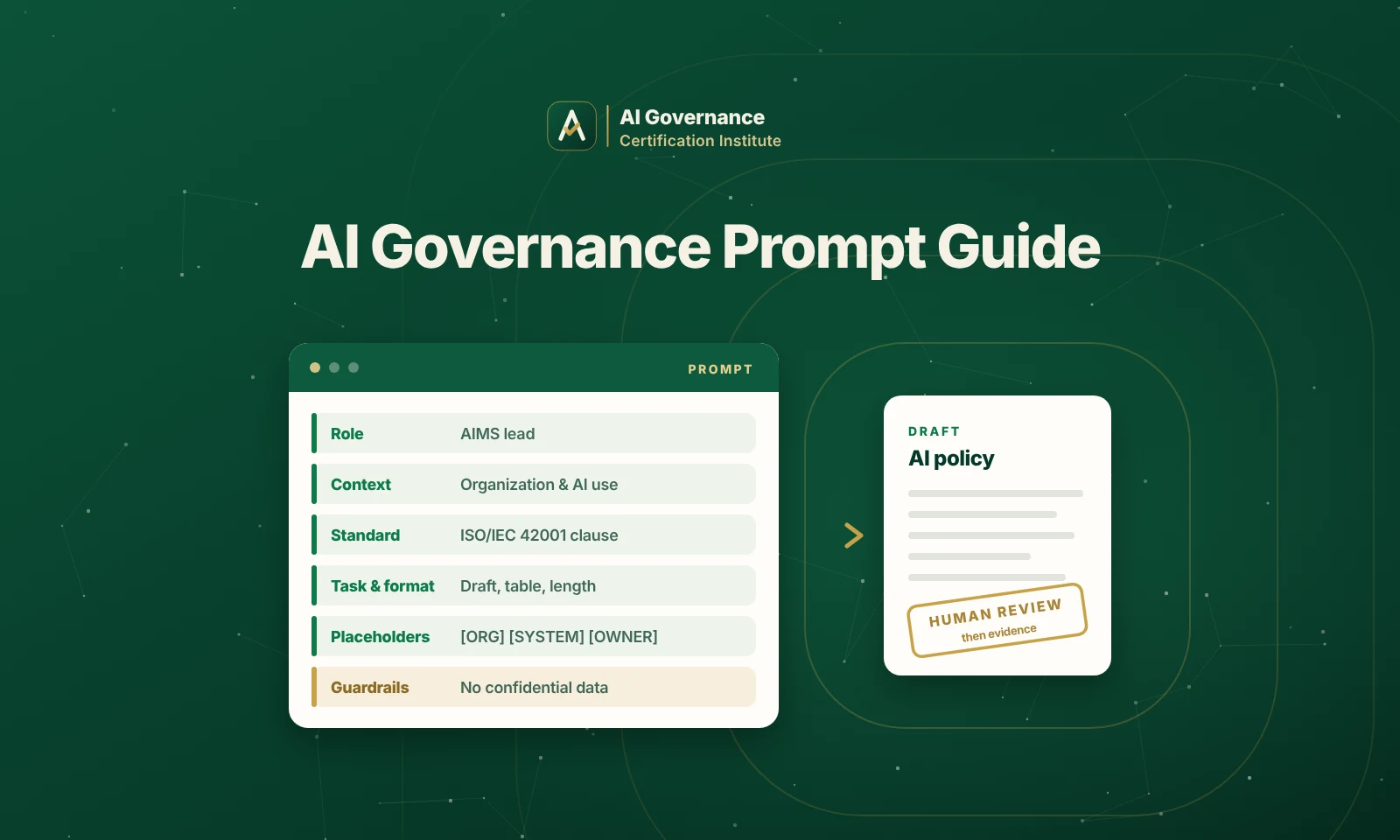
Most libraries hand you a prompt without showing you how it is built, which leaves you unable to adapt it. A reliable governance prompt has six parts, and knowing them lets you write your own for any artifact.
|
Element |
Why It Matters |
Example |
|
Role |
Sets the frame and the vocabulary the model uses |
Act as an AI governance specialist |
|
Context |
Makes the output specific to you, not generic |
Our sector, systems, and users |
|
Standard reference |
Anchors structure to real requirements |
Align to ISO/IEC 42001:2023, Clause 6 |
|
Task and format |
Gives you something usable |
Produce a risk register as a table |
|
Placeholders |
Force real inputs, since output follows them |
Risk tolerance, regulations, current policy |
|
Guardrails |
Reduce invented facts and false confidence |
Flag uncertainty, do not fabricate |
The last row is the one people miss. Without an explicit instruction to flag uncertainty and avoid inventing clauses or controls, a model will fill gaps with confident-sounding fiction, which in governance is worse than a blank page.
Prompts Mapped to the ISO 42001 Documents You Need
The value of a governance prompt guide is not a long menu of clever prompts. It is one prompt for each document the standard asks you to produce, so the output lands as a real deliverable rather than an interesting answer. The map below pairs the core documents with what to prompt for, and each of these documents also has a worked version among the templates.
|
Governance Document |
Clause |
What to Prompt For |
Output |
|
AIMS scope |
4.3 |
A first-draft scope with inclusions and exclusions |
Scope statement |
|
AI policy |
5.2 |
Principles, roles, acceptable use, review cycle |
Policy draft |
|
AI risk assessment |
6.1.2 |
Risks by group, likelihood, impact, controls |
Risk register |
|
Statement of Applicability |
6.1.3 |
Control applicability and justification prompts |
SoA draft |
|
Impact assessment |
6.1.4 |
Effects on people, groups, and society |
Impact assessment |
|
Regulatory gap analysis |
n/a |
Practices compared against a named regulation |
Gap table |
Two of these reward careful prompting most. A risk assessment prompt grounded in a framework such as the NIST AI Risk Management Framework gives you a structured first pass at risks you might miss, and an AI system impact assessment prompt forces you to name who is actually affected, which is exactly the question an auditor will press on.
Free Prompts You Can Copy
Here are three well-built prompts you can use today. Each names a role, anchors to the standard, leaves placeholders for your details, and includes guardrails against invented facts. Replace the bracketed parts with your own information before running them.
AI Policy First Draft
|
You are an AI governance specialist helping [organization and sector] draft an AI policy for an AI management system aligned to ISO/IEC 42001:2023. AI systems in scope: [list]. Draft a policy covering purpose and scope, the principles the organization commits to (fairness, transparency, accountability, safety, human oversight), roles and responsibilities, the approach to AI risk and acceptable use, regulatory commitments, and a review cycle. Keep it specific to the systems listed. Flag any section where you lack information, and do not invent facts about the organization. |
AI Risk Assessment
|
Act as an AI risk analyst. For the AI system [name and purpose], used by [users] in [context], identify the main risks to affected individuals and groups across fairness, safety, privacy, security, and transparency. For each risk give a plain-language description, who is affected, a likelihood and impact rating on a simple scale, and candidate controls. Present it as a risk register table. Mark any risk where you are uncertain, and do not present guesses as findings. |
Regulatory Gap Analysis
|
You are a compliance analyst. Compare the AI governance practices summarized below against the obligations that apply to an AI system classified as [risk category]. Current practices: [paste summary]. Produce a table with each relevant obligation, whether the current practice appears to meet it, the gap if any, and a suggested action. Only list obligations you are confident apply, and note clearly where the official regulation text should be checked directly. |
These three cover the documents people reach for first. The full library, with a prompt for every document from scope statement through management review and refined against real audits, is part of the full practical toolkit.
Where the Prompt Stops and You Begin
A prompt output is a draft, and the gap between a draft and a governed system is the whole job. Three limits are worth naming plainly.
• A draft is not evidence. An auditor checks whether controls actually run, not whether a document reads well. The model cannot generate the evidence, only the description of it.
• Generic until tailored. Out of the box the output describes a generic company. The value appears only when you replace its assumptions with your real systems, risks, and decisions.
• Confident fiction. Models invent clauses, controls, and obligations that sound right. Every reference to the standard or a regulation has to be checked against the source text.
Read against that list, prompts are an accelerant for the drafting, not a substitute for the governing. The judgment, the controls, and the proof remain yours.
A Workflow That Respects the Limits
The way to get the speed of a prompt without the risk is to treat the output as the first step of a short workflow, not the finished article. Five steps turn a draft into a record you can stand behind.
• Prompt for the draft, with the role, context, standard reference, and guardrails all in place so the output starts close to usable.
• Check every claim against the source, confirming that each clause, control, and obligation the model cited is real and genuinely applies to you.
• Tailor it to your systems, replacing the model’s generic assumptions with your actual scope, your real risks, and the decisions your organization has made.
• Build the real control behind each line, because the record only becomes true once the activity it describes actually exists and operates.
• Review, approve, and version it, so a named person owns the document and it enters your document control like any other record.
Run that loop and the prompt saves you the blank-page effort, while the part that decides whether you pass an audit, the judgment and the evidence, stays exactly where it belongs. The order matters too: skip the checking and tailoring and you ship confident fiction faster, which is the opposite of what a governance tool should do.
The Risk Hiding in the Prompt: Your Data
There is a governance failure built into careless prompting, and it is easy to miss. Pasting a confidential policy, a populated risk register, customer records, or personal data into a public model can expose exactly the information your AI management system is supposed to protect. The convenience of the prompt becomes a data incident.
Handle it the way you would any other AI risk. Decide what may and may not be shared with an external model, strip or synthesize sensitive details before prompting, and use approved tools with appropriate data handling for anything genuinely confidential. A prompt guide that ignores this is teaching a shortcut that fails its own standard.
Governing How Your Team Uses Prompts
The other side of this guide is that your own use of prompts is an AI activity, and the standard expects you to govern it. That is not bureaucracy; it is the same discipline applied one level up.
In practice that means a short acceptable-use position on which models may be used for governance work, a simple risk tiering so that a low-stakes internal draft is treated differently from a regulated or customer-facing output, and a human review step before any prompted draft becomes an official record. These are ordinary ISO/IEC 42001:2023 controls, acceptable use and human oversight, pointed at your own tooling, and they belong in the same management system that governs everything else you build.
Frequently Asked Questions
Can a Chatbot Write an AI Governance Policy?
It can write a credible first draft fast, and that is a real saving. What it cannot do is make the policy true: the commitments have to reflect decisions your leadership has actually taken, and the policy has to match controls that actually run. Use the draft as a scaffold, then tailor it and back it with real activity before it becomes your policy.
Are AI-Generated Governance Documents Audit-Ready?
No. A certification audit tests whether the records reflect real controls and decisions, not whether a document is well written. A prompted draft that has been tailored, approved, and backed by genuine evidence can become audit-ready; the raw output on its own is not.
What Should I Never Put in a Governance Prompt?
Anything you would not want to leave your organization: confidential policies, populated risk or incident data, customer records, and personal data, especially in a public or consumer model. Summarize or anonymize first, and reserve genuinely sensitive material for approved tools with appropriate data handling.
Which Governance Tasks Suit Prompts Best?
Drafting and structuring work: first-draft policies, a starting risk register, a gap analysis against a regulation, and plain-language explanations of a control. Tasks that require a decision, such as accepting a residual risk or signing off a control, are for people, not prompts.
Do I Still Need Templates if I Have Prompts?
Yes, and they work best together. A prompt speeds the first draft; a standard-mapped template gives you the structure an auditor expects and a worked example to check the draft against. Prompts fill the page faster, templates keep the page correct.
From Prompts to a Governed System
Prompts are a fast way to draft the work, but a certificate rests on a system that is governed, evidenced, and owned. Learning to build that, and to use these drafting shortcuts without leaning on them, is what structured training does. You can see every route through the ISO 42001 courses, with the implementer path taught clause by clause in the Lead Implementer certification so the documents you prompt for become a system you can defend.