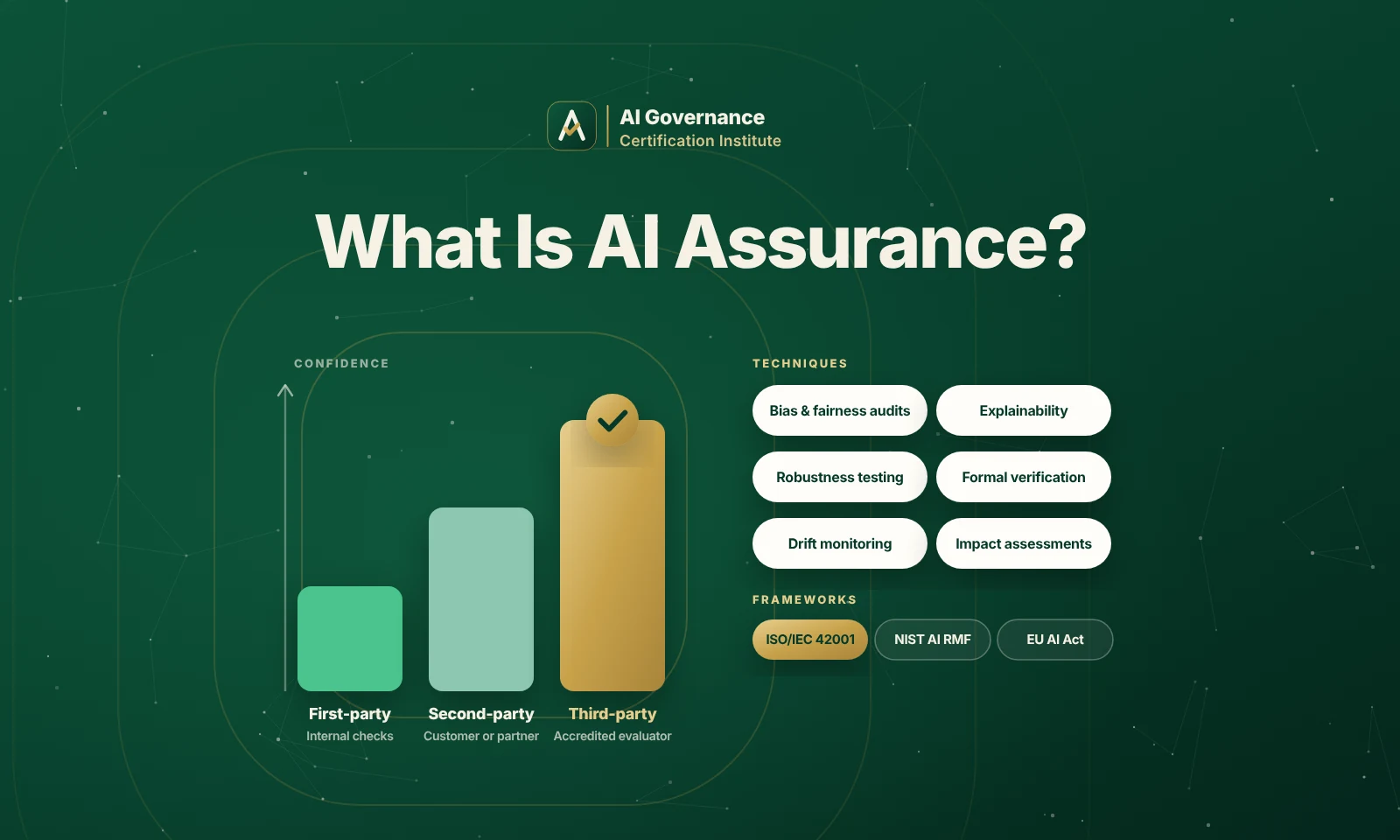
AI assurance answers a question that gets harder as AI gets more capable: how do you know an AI system does what it claims, safely and fairly, and how do you prove it to someone else? It is, in essence, the discipline of replacing blind trust in AI with justified confidence, backed by real evidence rather than assertion.
Put formally, AI assurance is the process of measuring, evaluating, and communicating the trustworthiness of AI systems. The UK government's introduction to AI assurance frames it as the way organizations measure whether their systems are trustworthy and then demonstrate that to government, regulators, and the market. The key word is demonstrate: assurance is not just being trustworthy, but being able to show it.
This guide from the AI Governance Certification Institute (AIGCI) explains what AI assurance means, why it exists, the techniques and ecosystem behind it, and where ISO 42001 fits within the bigger picture. One quick clarification first, because search engines confuse it constantly: AI assurance is not AI insurance. Assurance is about evidence and trust in the system; insurance is a financial product. They are unrelated.
What AI Assurance Means
At its core, AI assurance generates credible evidence that an AI system is safe, ethical, reliable, and legally compliant. As Partnership on AI and others describe it, the goal is justified confidence: trust that is earned through testing and evidence rather than assumed. It spans the whole life of a system, from before deployment through ongoing operation, because an AI system that was trustworthy at launch can drift out of that state over time.
Assurance is broader than any single check. It is the combination of techniques, the people who perform them, the standards they measure against, and the regulations and market forces that make organizations bother with it in the first place. Seen that way, AI assurance is less a product and more an ecosystem, which is the next thing to understand.
Why AI Assurance Exists: Closing the Trust Gap
AI assurance exists because there is a gap between what an AI system is claimed to do and what anyone can actually verify it does. That gap is wider for AI than for most technology, for three reasons.
-
Opacity. Many AI systems are hard to interpret, so you cannot simply read the code to know how they decide.
-
Stakes. AI increasingly affects credit, hiring, health, and safety, where being wrong has real consequences for real people.
-
Change. AI systems drift as data and the world change, so a one-time check does not stay true.
Assurance closes that gap by producing evidence a third party can rely on. Without it, trust in AI rests on the vendor's word, which is exactly the situation regulators and buyers are no longer willing to accept, and the reason assurance has grown into a field of its own.
The AI Assurance Ecosystem: Four Pillars
A useful way to see AI assurance is as a mutually reinforcing ecosystem with four pillars, each answering a different part of the trust problem.
-
Techniques and tools. The technical and procedural methods applied across the AI lifecycle to test and evaluate systems.
-
Standards and frameworks. The baseline definitions of what makes an AI system trustworthy, so everyone measures against the same bar.
-
Assurance providers. The independent evaluators, auditors, and technical experts who actually perform the assessments.
-
Incentive and governance structures. The regulations, market demands, and accreditations that compel or reward organizations for seeking assurance.
No single pillar is enough on its own. Techniques without standards produce results no one can compare; standards without providers go unapplied; and without incentives, few organizations do any of it until something goes wrong.
The Techniques of AI Assurance
Assurance does not rely on one test but combines overlapping methods across the lifecycle. These are the techniques an assurance effort draws on:
|
Technique |
What It Checks |
|---|---|
|
Bias and fairness audits |
Whether outputs disadvantage protected or vulnerable groups |
|
Explainability assessments |
How a model reaches its decisions, and whether that can be explained |
|
Robustness and adversarial testing |
Stability under edge cases, data poisoning, and targeted attacks |
|
Formal verification |
Whether defined safety properties hold across all possible inputs |
|
Continuous monitoring and drift detection |
Degradation, data drift, and concept drift after deployment |
|
Impact assessments |
Effects on people, rights, and society before a system is deployed |
Where ISO 42001 Fits in AI Assurance
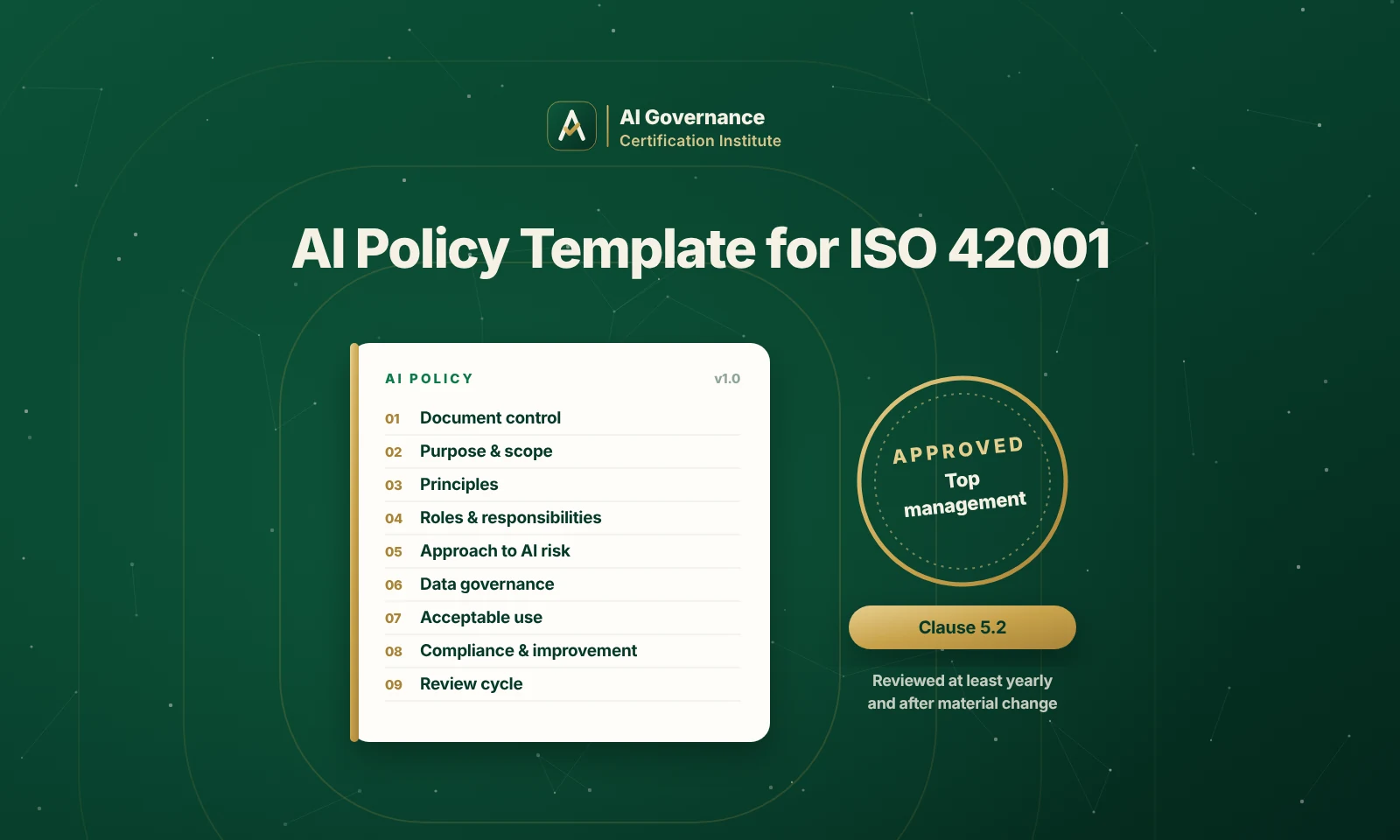
AI assurance has many instruments, and ISO 42001 is one of the most important: the management-system instrument. Where a bias audit assures one model and a robustness test assures one property, ISO 42001 assures the organization's whole approach to governing AI, by certifying that it runs a working AI management system. It sits alongside risk frameworks like the NIST AI Risk Management Framework and regulations like the EU AI Act as part of the standards-and-frameworks pillar, and it is verified through the certification audit that an accredited body performs.
The distinction matters. Technique-level assurance answers is this model fair or robust; management-system assurance answers can this organization be trusted to keep its AI systems fair and robust over time. A mature assurance program uses both, because a trustworthy organization with an untested model, or a well-tested model inside an ungoverned organization, each leaves a gap.
The Push From Regulation and the Market
AI assurance is moving from nice-to-have to expected, and two forces are driving it.
The first is regulation. The EU AI Act requires conformity assessment for higher-risk AI systems, and national guidance in several countries is pushing organizations to demonstrate structured proof rather than assert good intentions. That turns assurance from a choice into a condition of operating in those markets. The second is the market itself: enterprise buyers increasingly ask suppliers to prove their AI is governed before signing, so assurance has become a commercial asset that shortens sales and satisfies procurement. Together these form the incentive pillar of the ecosystem, the reason organizations invest in assurance before something forces them to.
AI Assurance, Conformity Assessment, and Certification
Three terms travel together in this space and are easy to blur. AI assurance is the broad activity of generating and communicating evidence of trustworthiness. Conformity assessment is a specific form of assurance: demonstrating that a system or organization meets a defined standard or regulation. Certification is the outcome when an accredited body confirms that conformity and issues a certificate.
In other words, conformity assessment is one route through the assurance ecosystem, and certification is one of its possible endpoints. ISO 42001 certification is assurance delivered through conformity assessment; a bias audit is assurance delivered through a technique. Both produce evidence of trustworthiness, by different means and at different levels.
First, Second, and Third-Party Assurance
Assurance also differs by who provides it, and the level changes how much weight it carries. First-party assurance is the organization checking itself, such as an internal audit or self-assessment. Second-party assurance is a customer or partner checking a supplier. Third-party assurance is an independent body with no stake in the outcome, which is the most credible because it is the hardest to bias. The independent auditors who perform third-party management-system assurance include the Lead Auditor who performs it, trained specifically to assess an AI management system against the standard.
The more independent the provider, the more the assurance is worth to an outside party. That is why a self-declared claim carries less weight with a regulator or a buyer than an accredited third-party certificate, even when the underlying system is identical.
How Organizations Build an Assurance Program
Assurance is not bought in a single purchase; it is assembled piece by piece over time. Organizations that do it well tend to follow a recognizable path.
-
Inventory the AI systems. You cannot assure what you have not listed, so the program starts with knowing what AI you run.
-
Match techniques to risk. Higher-stakes systems get deeper assurance, such as bias audits and impact assessments, while low-risk tools need less.
-
Measure against a standard. Anchor the program to a recognized framework so the evidence means the same thing to outsiders.
-
Produce and keep evidence. Assurance is only worth as much as the records that back it, so evidence has to be generated and retained.
-
Bring in independent review. Add third-party assurance where it matters most, because independence is what makes the evidence credible to regulators and buyers.
A management system like the one ISO 42001 defines is a common backbone for this, because it organizes the inventory, the risk-based selection, and the evidence into one coherent program rather than a set of disconnected tests.
Frequently Asked Questions
What Is AI Assurance in Simple Terms?
It is the process of testing and evaluating an AI system to show it is trustworthy, and then communicating that evidence to others. Instead of asking people to take an AI system's safety or fairness on trust, assurance produces proof that regulators, customers, and the public can rely on.
Is AI Assurance the Same as AI Insurance?
No, and the two are often confused in search results. AI assurance is about generating evidence that an AI system is trustworthy, through testing, audit, and evaluation. AI insurance is a financial product that pays out if something goes wrong. They address completely different problems and are not related.
What Techniques Are Used in AI Assurance?
A combination, rather than any single test: bias and fairness audits, explainability assessments, robustness and adversarial testing, formal verification, continuous monitoring and drift detection, and impact assessments. These are applied across the AI lifecycle, because assurance has to cover a system before, during, and after deployment.
Is ISO 42001 a Form of AI Assurance?
Yes, and an important one. ISO 42001 provides management-system assurance: a certificate from an accredited body confirming that an organization runs a working AI management system. It assures the organization's overall governance of AI, complementing technique-level assurance such as bias audits that evaluate individual models.
Who Provides AI Assurance?
Is AI Assurance Becoming a Career?
Yes. As regulation and market demand grow, so does the need for people who can perform assurance credibly, including AI auditors, assurance specialists, and governance leads. Professional credentials in AI management systems, such as Lead Implementer and Lead Auditor, are a common way into the field, because they certify the competence the assurance ecosystem is short of.
A range of providers, depending on the level. Internal teams provide first-party assurance; customers provide second-party assurance of their suppliers; and independent evaluators, auditors, and technical experts provide third-party assurance, which carries the most weight because it is the most independent. For management systems, accredited certification bodies and their auditors are the third-party providers.
What Is the Difference Between AI Governance and AI Assurance?
AI governance is the set of policies, roles, and processes an organization uses to manage AI responsibly; AI assurance is the evidence that the governance and the systems actually work. Governance is what you do, assurance is how you prove it. The two are linked, because good governance is what makes credible assurance possible, which is why ISO 42001, a governance framework, is also one of the strongest assurance instruments.
Turn Assurance Into a Credential
AI assurance is becoming a profession as much as a practice, and the organizations and individuals who can perform it credibly are in growing demand. Building that capability starts with understanding how governance, standards, and evidence fit together. You can see every route through the ISO 42001 courses, with the implementer path taught clause by clause in the Lead Implementer certification, so you can help build the trust that AI assurance exists to prove.