The certification audit is the exam your AI management system has to pass, and unlike most exams it comes in two sittings. An accredited certification body checks your system on paper first, then checks whether the paper is true in practice. Passing both is what turns a management system into an ISO 42001 certificate.
This two-stage model is not unique to AI; it is the standard approach to conformity assessment used across ISO management system standards, carried out by bodies that meet the requirements for auditing and certifying AI management systems set out in ISO/IEC 42006. The logic is simple: there is no point testing whether a system runs well if it was never designed correctly, so the design is checked first and the operation second.
This guide from the AI Governance Certification Institute (AIGCI) walks through both stages, the gap between them, what the auditor looks for in each, how nonconformities are graded, and how to prepare so neither stage holds a surprise.
The Two-Stage Model, and Why It Exists
A certification audit is a structured, evidence-based examination, and splitting it into two stages protects both sides. Stage 1 confirms the system is designed and documented correctly before anyone spends days testing operations that might rest on a flawed design. Stage 2 then confirms the design is actually lived, not just written. Running them in that order means a company is not put through a full operational audit only to fail on a missing policy that a shorter review would have caught.
Both stages are performed by the same accredited body, and together they lead to a single decision: whether to issue the certificate. Understanding what each stage is actually looking for is the difference between walking in prepared and walking in hopeful.
Stage 1: The Readiness and Documentation Review
Stage 1 evaluates whether your AI management system is designed and documented well enough to meet the standard, before any deep operational testing. It is a review of the blueprint, not the building.
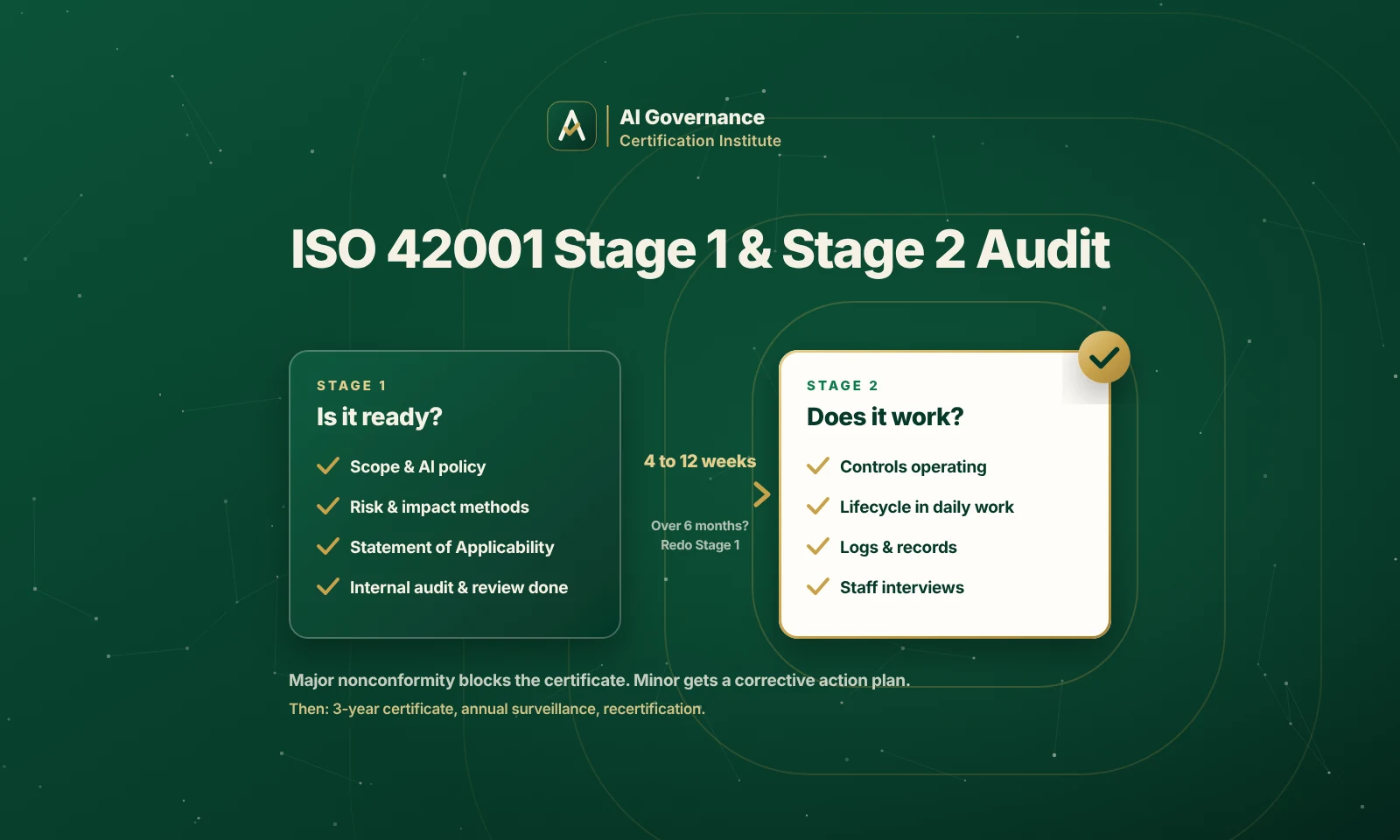
The auditor examines the AIMS scope, the AI policy, objectives, and high-level procedures; how you identify and assess AI risks and run impact assessments; and your Statement of Applicability for the Annex A controls. Crucially, Stage 1 also checks readiness prerequisites, and the two that trip organizations most are that a full internal audit and a management review have already been completed. If the internal audit that prepares you has not run, you are not ready for Stage 1, no matter how good the documents look.
The activities are document walkthroughs, on-site or remote, and interviews with system owners and key stakeholders. The outcome is a formal report listing any areas of concern or nonconformities. If significant gaps are found, you are given time to fix them before Stage 2 is scheduled.
Between the Stages: Closing the Gap
Stage 1 and Stage 2 are not back to back. The gap between them is the time to remediate what Stage 1 found, and it is both a practical necessity and a scheduling constraint.
That gap is commonly a few weeks to a couple of months, often quoted as four to twelve weeks, and it should not stretch past six months, or Stage 1 has to be repeated. Use it deliberately: close the areas of concern, finish any evidence that was thin, and make sure the operation the auditor will test in Stage 2 has actually been running. A gap spent waiting rather than fixing is a wasted one.
Stage 2: The Implementation and Effectiveness Audit
Stage 2 is the deeper audit, and it answers a different question from Stage 1: not is the system designed correctly, but does it actually work in practice across your AI systems.
The auditor tests the operational effectiveness of the controls, verifies that AI risk management and lifecycle processes are embedded in day-to-day work rather than living only in documents, and reviews concrete evidence: logs, records, monitoring results, and competence and training records. The activities go wider and deeper than Stage 1, with interviews across engineering, product, legal, and executive teams, and live walkthroughs of governance workflows and the risk register. The outcome is a list of any major or minor nonconformities, and once those are resolved, the accredited body issues the certificate, valid for three years and subject to annual surveillance.
Who the Auditor Talks To
Stage 2 is not a documentation exercise; it is a conversation with the people who actually run the system, and that catches organizations who prepared only the paperwork.
The auditor interviews across the organization, not just the compliance team: engineers who build and monitor the models, product owners who decide how AI is used, legal and risk staff who own the impact and compliance questions, and executives who approved the policy and the resources. The reason is simple. A governed system shows up the same way whether you ask the person who wrote the policy or the person who has to follow it day to day, and a gap between the two is exactly what the cross-team interviews are designed to find. The practical lesson is to prepare the people who operate the controls to describe them in their own words, not to rehearse a script.
Major Versus Minor Nonconformities
Not every finding carries the same weight, and knowing the difference tells you how much trouble a finding really is.
-
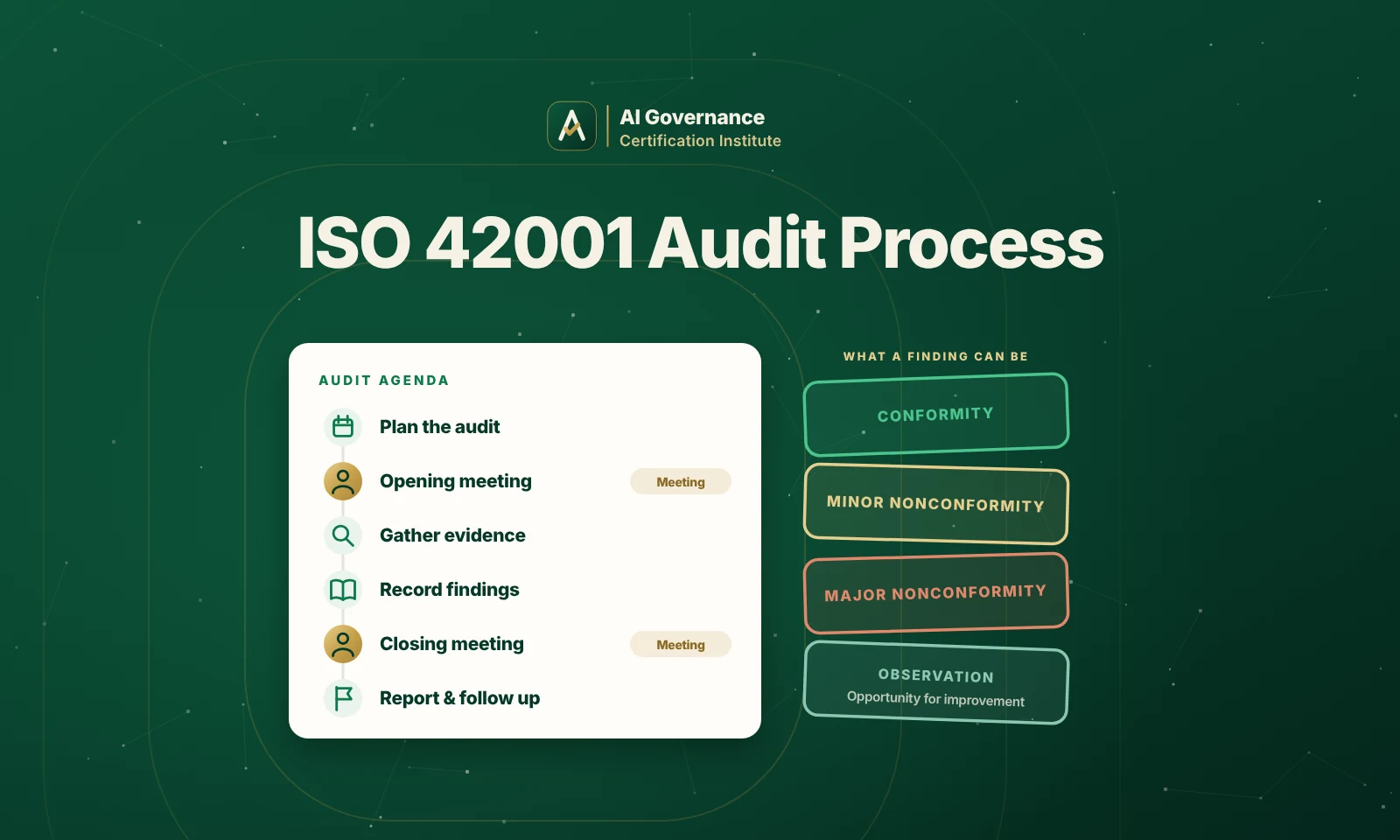
Major nonconformity. A requirement that is not met in a way that undermines the system's ability to work, such as a missing required process or a control that does not function. A major finding blocks certification until it is corrected and verified.
-
Minor nonconformity. An isolated lapse that does not undermine the whole system, such as a single record that was not kept. Minors usually allow certification to proceed on an agreed corrective action plan.
The practical goal of preparation is to walk into Stage 2 with no majors and few minors, because majors are what turn a certification audit into a second attempt.
What the Auditor Checks, and What You Provide
Each stage pairs an auditor focus with the evidence you have to be ready to show. The table makes the two sides explicit.
|
Stage |
What the Auditor Focuses On |
What You Provide |
|---|---|---|
|
Stage 1 |
Design and documentation: scope, policy, SoA, risk and impact methods, readiness |
The documented AIMS, plus evidence that internal audit and management review are done |
|
Stage 2 |
Operation and effectiveness: controls running, evidence, competence |
Records, logs, monitoring results, and people who can show the controls work |
How to Prepare for Each Stage
Preparation is mostly about sequence, because the standard builds the prerequisites into the audit itself.
-
Finish the internal cycle first. Complete a full internal audit and a management review before Stage 1, because the auditor checks that both have happened.
-
Get the documents coherent. Make sure the scope, policy, risk work, and Statement of Applicability tell one consistent story.
-
Operate long enough to leave evidence. Stage 2 tests records, so the controls have to have actually run before the auditor arrives.
-
Prepare the people, not just the papers. Stage 2 interviews real staff, so the people who run controls should be able to describe them.
Do these and both stages become confirmations rather than discoveries. The wider path into and out of the audit is covered in how to get certified.
Common Certification Audit Mistakes
A few avoidable errors turn a manageable audit into a stressful one:
-
Scheduling Stage 2 too soon. Booking the operational audit before the controls have run long enough to leave evidence.
-
Skipping the prerequisites. Arriving at Stage 1 without a completed internal audit and management review, which the auditor checks for first.
-
Thin or disorganized evidence. Having controls that work but no records an auditor can sample to prove it.
-
Staff who cannot describe the controls. Documents that say one thing while the people who run the system say another.
-
A Statement of Applicability that does not match reality. Controls marked applicable with no evidence, or exclusions with no justification.
After You Pass: The Certificate and Beyond
Passing Stage 2 earns a certificate valid for three years, but it is not the end of the auditing. The certification body returns for annual surveillance audits to confirm the system is still operating and improving, with a fuller recertification before the three years are up. Those lighter, recurring checks are covered in the surveillance audit, and they are the reason a certificate is a commitment to keep rather than a prize to file.
Frequently Asked Questions
What Are Stage 1 and Stage 2 of the ISO 42001 Audit?
Stage 1 is a readiness and documentation review that checks whether the AI management system is designed and documented correctly, including that internal audit and management review are done. Stage 2 is a deeper audit that tests whether the system actually operates effectively, through evidence, records, and interviews. Both are performed by an accredited certification body.
How Long Is the Gap Between Stage 1 and Stage 2?
Commonly a few weeks to a couple of months, often cited as four to twelve weeks, to give you time to close Stage 1 findings. It should not exceed six months, or the Stage 1 audit has to be repeated, so the gap is for remediation, not delay.
What Happens if You Fail the Certification Audit?
You are not usually failed outright; you are given nonconformities to resolve. A major nonconformity must be corrected and verified before the certificate can be issued, while minor ones can often be handled on a corrective action plan. The audit becomes a second attempt only when major findings are not closed.
Who Performs the ISO 42001 Certification Audit?
An independent, accredited certification body, not ISO and not the organization itself. The body must meet the requirements for auditing and certifying AI management systems, and its accreditation is what gives the resulting certificate its weight in the market and with regulators.
How Long Does the Certification Audit Take?
The on-site audit itself is usually a matter of days per stage, with Stage 2 longer than Stage 1, but the elapsed time includes the remediation gap between the stages. The total depends on the scope and the number of AI systems being certified rather than on a fixed duration.
Walk In Prepared, Not Hopeful
The organizations that pass both stages cleanly are the ones whose people understand what each stage is really testing and have the evidence ready. That readiness is built through training. You can see every route through the ISO 42001 courses, with the implementer path taught clause by clause in the Lead Implementer certification, so the certification audit confirms what you already know to be true.