An accredited ISO 42001 certificate can be checked against a global database that already holds more than 1.1 million accredited certificates from over 1,300 certification bodies, IAF CertSearch. That means you never have to take a certificate on trust. Verifying one comes down to four quick checks: read what the certificate actually says, search the accredited database, confirm the details with the issuer independently, and check the standard, scope, and dates line up. This guide walks through each step for an organization's certificate, and shows how to verify an individual's professional certification through its digital badge. The AI Governance Certification Institute (AIGCI) wants both to be simple to confirm.
To verify an ISO 42001 certification, read the certificate details, search the accredited-certification database, confirm directly with the issuing body, and check that the standard, scope, and dates all match.
What a genuine ISO 42001 certificate should show
Verification starts with knowing what you are looking at. A legitimate, accredited certificate names the certification body and its accreditation body, states the exact standard (ISO/IEC 42001), defines the scope of what is certified, and carries an issue date, an expiry date, and a unique certificate number. If any of these is missing or vague, that alone is a reason to look closer. The International Organization for Standardization is clear that it does not issue certificates itself, so a genuine certificate always comes from an independent certification body, not from ISO.
How to verify an organizational certificate in four steps
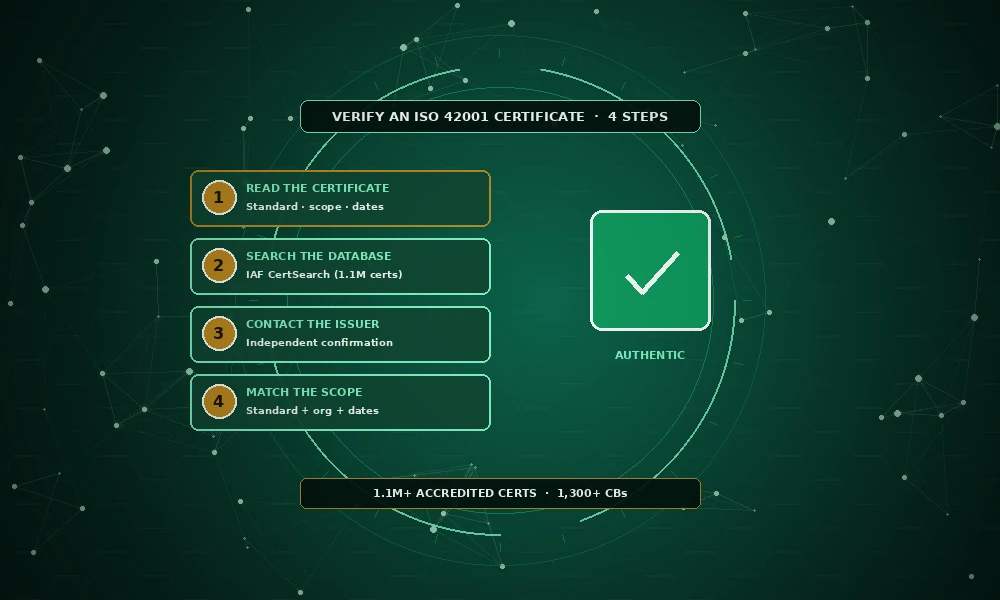
For a company's certificate, work through these four checks in order. Most take a minute or two, and together they are decisive.
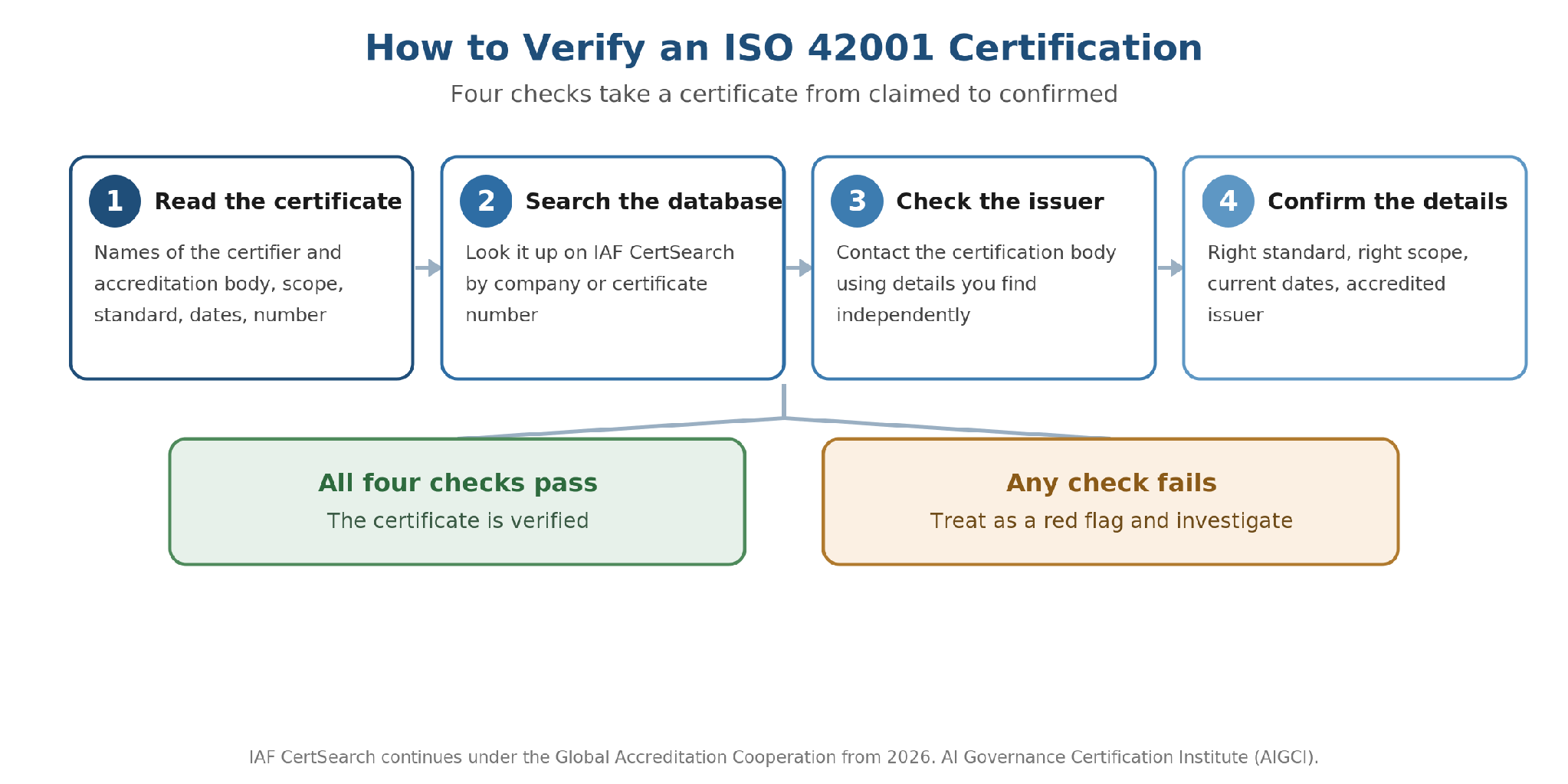
Figure 1. Four checks that take an ISO 42001 certificate from claimed to confirmed.
Step one: read the certificate for the key details
Note the certification body, the accreditation body, the standard, the scope, the dates, and the certificate number. These are the facts every later step will confirm.
Step two: search the accredited-certification database
Enter the organization's name or the certificate number into IAF CertSearch, the global database that consolidates accredited certifications from accreditation and certification bodies in one place. If the certificate is genuine and accredited, it appears there, along with confirmation that the issuing body is accredited for ISO 42001.
Step three: confirm with the issuer, independently
Contact the certification body directly, using contact details you find yourself rather than the number printed on the certificate, which a forger could fake. You can also confirm that the accreditation body is part of the international accreditation system through a body such as ANAB or the wider accreditation forum register. A real issuer will confirm the certificate in moments.
Step four: check the standard, scope, and dates match
Finally, confirm the certificate is for ISO/IEC 42001 specifically, that its scope covers the activity you care about, and that it is currently valid rather than expired. A certificate that is real but out of scope or lapsed does not give you the assurance you need.
How to verify a professional certification and its digital badge
Verifying an individual's credential works differently. A professional certification is confirmed through the issuing body's own register, and increasingly through a verifiable digital badge that links back to a live record showing the holder's name, the credential, and its status. If someone shares a badge, follow it to its source rather than trusting a screenshot. Our guide to the digital badge and accreditation explains what a trustworthy badge looks like and how the accreditation behind it works.
Red flags that a certificate is fake or unaccredited
A few signals should stop you in your tracks. There is no accreditation body named or shown. The certificate does not appear in the accredited database. The scope is vague or generic rather than specific. There is no certificate number, or no way to check it. The only contact route is a number printed on the certificate itself. Or the dates suggest an implausibly short audit. Any one of these means the certificate needs a closer look before you rely on it.
Why verifying and recognising a certificate go together
Verification and recognition are two halves of the same question. Verification confirms a certificate is real; recognition confirms it carries weight, and both depend on the accreditation behind it, which is why whether it is recognised is worth reading alongside this guide. In short, read the certificate, search the accredited database, confirm with the issuer, and check the standard, scope, and dates. Do those four things and you will know, quickly and confidently, whether an ISO 42001 certificate is genuine.
Frequently asked questions
How do I check if an ISO 42001 certificate is real?
Read the certificate for the issuer, standard, scope, dates, and number, then search the accredited-certification database and confirm with the issuing body using contact details you find independently. If it appears in the database and the issuer confirms it, it is genuine.
Where can I verify an accredited ISO 42001 certificate?
Use IAF CertSearch, the global database for accredited management system certifications. You can search by the organization's name or the certificate number to confirm both the certificate and the issuer's accreditation.
Does ISO keep a register of certified companies?
No. ISO writes the standard but does not certify organizations or maintain a certificate register. Verification is done through the certification body, the accreditation body, and the accredited-certification database.
How do I verify someone's professional ISO 42001 certification?
Check the issuing body's register, or follow the person's verifiable digital badge to its live source. Do not rely on a screenshot or a PDF alone, since only the live record confirms current status.
What should I do if I think a certificate is fake?
Do not rely on it, and report it to the relevant accreditation body. A genuine certificate will always be confirmable through the database or the issuer, so anything that cannot be confirmed should be treated with caution.
Earn a certification others can verify
Trust runs both ways: the credentials worth holding are the ones anyone can check. AIGCI's verifiable ISO 42001 certifications are built to be confirmed, through proper issuance and clear records, so what you earn stands up to exactly the checks described here. To see how the institute approaches this, read more about the institute..