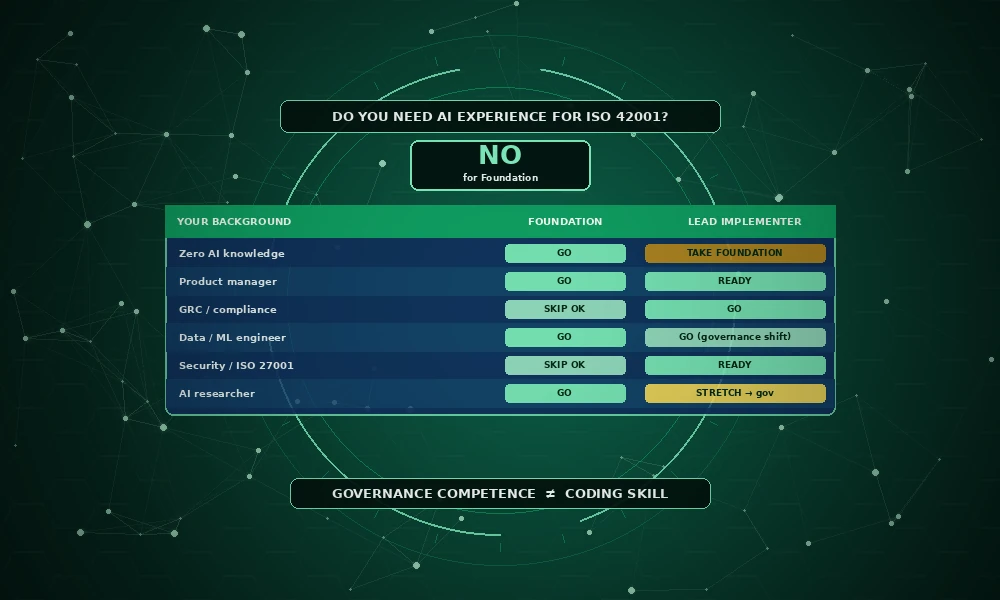
If you are drawn to ISO 42001 but worried that a lack of hands-on AI experience rules you out, here is the reassuring short answer: it does not. At the AI Governance Certification Institute (AIGCI), the Foundation certification has no prerequisites and is built for people who are new to AI governance. ISO 42001 is a management-system standard, so what it really asks for is the ability to govern AI responsibly, not the ability to build it.
What counts as “experience” does shift as you move toward the professional certifications, and the honest picture has a little more nuance there. This page gives you the straight answer for each AIGCI certification level, explains which background actually helps, and points you to the one that fits where you are today.
The short answer: you can start ISO 42001 with no prior AI experience
Anyone can begin. The AIGCI Foundation certification is designed for beginners and assumes no prior work in AI, so a student, a career changer, or a manager new to the topic can all take it and pass. Prior exposure to AI or IT helps you absorb the material faster, yet it is not required to enrol or to succeed. If your only worry is that you have never trained a model or written AI code, you can set that worry aside.
This matters because the fear of being underqualified is the single biggest reason capable people delay starting. The truth runs the other way. AI governance is a young field, and the demand for people who can govern AI responsibly is growing quickly as regulation such as the EU AI Act takes effect, which is opening the door to professionals from many backgrounds rather than only AI researchers.
ISO 42001 tests governance ability, not coding
The standard governs how an organization manages AI. It does not ask you to develop AI. Earning and using an ISO 42001 credential rests on skills like risk assessment, documentation, policy, and audit rather than on machine-learning engineering. Data scientists and engineers implement some of the technical controls, but the management system itself is run by governance, risk, and compliance people.
That is why the standard is deliberately accessible. ISO/IEC 42001 uses the same management-system structure as ISO 27001 and ISO 9001, so if you have worked with any established management system, the shape is already familiar. Governance-first frameworks such as the NIST AI Risk Management Framework take the same view: managing AI responsibly is a discipline of oversight and process, not of writing code. The AI-specific parts, such as bias, transparency, human oversight, and impact on people, are concepts you can learn.
Foundation and Lead levels ask for different things
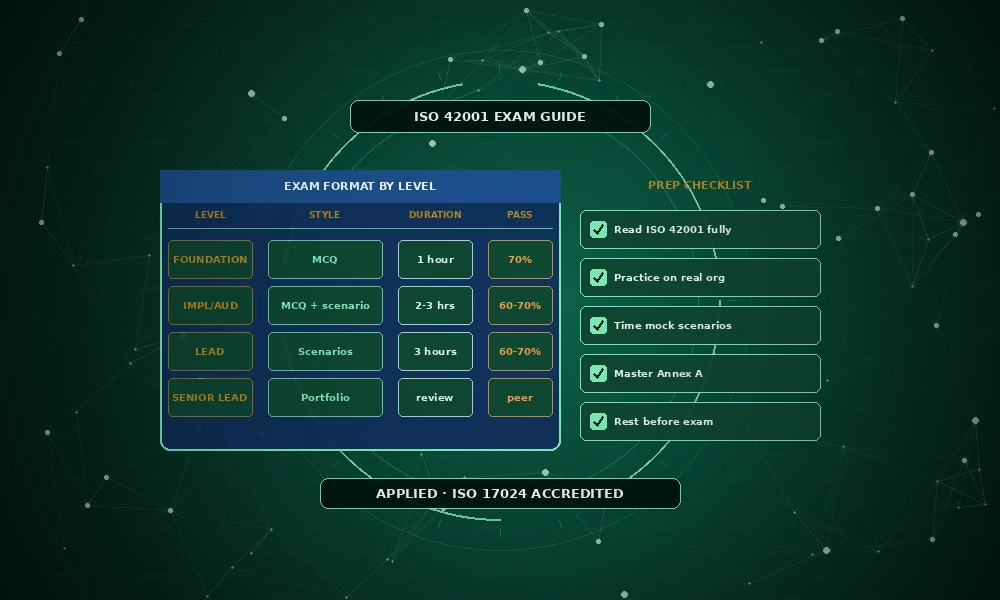
Experience becomes more relevant as you climb the certification ladder, which is worth understanding before you choose a level. The Foundation certificate expects nothing in advance. The professional levels, such as Lead Implementer and Lead Auditor, are built for people who bring some relevant professional experience and are comfortable with AI concepts. Importantly, that experience is usually in governance, IT, security, project management, or audit, not in building AI systems.
The cleanest way to see the difference is to compare the levels side by side. Our guide to the certification levels and requirements lays out what each one assumes, and the Lead Implementer requirements page covers that professional level in detail. If you are choosing between the first two rungs, the Foundation versus Lead Implementer comparison is the fastest way to decide.
|
Certification level |
AI experience needed |
What it really asks for |
|---|---|---|
|
Foundation |
None |
Willingness to learn the basics of AI governance; open to complete beginners |
|
Lead Implementer |
Helpful, recommended |
Relevant professional experience (governance, IT, security, or project delivery) and AI familiarity |
|
Lead Auditor |
Helpful, recommended |
Audit discipline plus AI familiarity |
Because the exact experience expectations can vary by level, treat any specific number of years as a detail to confirm for the certification you choose rather than a universal law. The principle holds throughout: no AI engineering background is required at any level.
What counts as relevant experience, and what does not
If you do have a few years of professional background, the good news is that most of it transfers. The table below shows which kinds of experience prepare you well for ISO 42001, and why.
|
Experience you may have |
Counts toward ISO 42001? |
Why it helps |
|---|---|---|
|
Governance, risk, and compliance (GRC) |
Yes, strongly |
The AIMS is a governance system; these are exactly the skills it runs on |
|
Information security or ISO 27001 |
Yes, strongly |
Same management-system structure, so implementers and auditors adapt quickly |
|
IT or project management |
Yes |
Implementation is a structured delivery project with stakeholders and milestones |
|
Internal or external audit |
Yes |
Auditing an AIMS uses the same discipline as auditing any management system |
|
Privacy or data protection |
Yes |
Overlaps with AI data governance and impact assessment |
|
Building or coding AI models |
Helpful, not required |
Useful context, but the standard governs AI rather than asking you to develop it |
|
No professional experience yet |
Start at Foundation |
No experience is required to begin learning and earn your first credential |
The ISO 42001 Experience Fit Guide: match your background to a starting point
Most pages stop at “it depends.” This guide turns your background into a clear next step. Find the row that best describes you today, confirm whether prior AI experience is needed, and see the AIGCI certification that makes the strongest starting point.
|
Your background |
Prior AI experience needed? |
Best place to start |
|---|---|---|
|
New to AI and governance (student or career changer) |
No |
Foundation certification |
|
GRC, risk, or compliance professional |
No |
Foundation, then Lead Implementer |
|
Security or ISO 27001 practitioner |
No |
Lead Implementer (add Foundation if new to AI concepts) |
|
IT or project manager |
No |
Lead Implementer |
|
Internal or external auditor |
No |
Lead Auditor or Internal Auditor |
|
AI or ML engineer, data scientist |
You already have the technical side |
Foundation, then Lead Implementer for the governance |
|
Executive or manager sponsoring AI |
No |
Foundation for working awareness |
Three quick myths worth retiring as you decide:
-
“I must be a data scientist.” The standard is about governance; most implementers come from security, risk, and compliance.
-
“Foundation needs AI experience.” It has no prerequisites and is built for beginners.
-
“Without AI experience I cannot add value.” Governance, documentation, and audit skills are precisely what an AIMS needs to run.
What counts as relevant experience
|
Experience you may have |
Counts toward ISO 42001? |
Why it helps |
|---|---|---|
|
Governance, risk, and compliance |
Yes, strongly |
The AIMS is a governance system built on these skills |
|
Information security or ISO 27001 |
Yes, strongly |
Same management-system structure, so you adapt quickly |
|
IT or project management |
Yes |
Implementation is a structured delivery project |
|
Internal or external audit |
Yes |
Auditing an AIMS uses the same discipline as other audits |
|
Privacy or data protection |
Yes |
Overlaps with AI data governance and impact assessment |
|
Building or coding AI models |
Helpful, not required |
Useful context, but the standard governs AI, not builds it |
|
No professional experience yet |
Start at Foundation |
No experience is required to begin |
Frequently asked questions
Do I need to know how to code to get ISO 42001 certified?
No. ISO 42001 governs how an organization manages AI, and certification is a governance and compliance activity rather than a programming one. You do not need to build models, write AI code, or understand machine-learning mathematics to earn or use the credential.
Can a complete beginner take ISO 42001?
Yes. The AIGCI Foundation certification has no prerequisites and is designed for people new to AI governance, including students and career changers. Prior exposure to AI or IT helps you learn faster, but it is not required to enrol or to pass.
Do I need AI experience for the Lead Implementer certification?
Familiarity with AI concepts is recommended, and the Lead level is built for people who bring some relevant professional experience. That experience is usually in governance, IT, security, project management, or audit rather than in AI development, so a non-technical background is a strong fit.
I come from a security or GRC background. Is ISO 42001 right for me?
It is one of the most natural next steps. The AIMS shares its structure with ISO 27001, so your management-system, risk, and audit skills transfer directly. Many people move into AI governance from exactly these backgrounds.
I am an AI engineer with no governance background. Where do I start?
Begin with the AIGCI Foundation certification to learn how the standard frames governance, then move to Lead Implementer to lead the work. You already hold the technical context; Foundation adds the governance language and structure you will use.
Can I take Lead Implementer without doing Foundation first?
In many cases yes, though it depends on your background. Our guide on whether you can take Lead Implementer without Foundation walks through when it makes sense and when starting at Foundation is the better choice.
Where to start, whatever your background
The honest bottom line is encouraging: you do not need prior AI experience to begin ISO 42001, and you never need to be an AI engineer to succeed at it. If you are new to the topic, the ISO 42001 Foundation certification is the confident first step and asks nothing of you in advance. When you are ready to lead the work, the ISO 42001 Lead Implementer certification builds on that base, while auditors can head toward the ISO 42001 Lead Auditor certification or the ISO 42001 Internal Auditor certification.
Every one of these credentials is offered by the AI Governance Certification Institute, which is built to take you from wherever you are today to a certification you can stand behind. Your background is more of an asset than you think, and the first step is genuinely within reach.